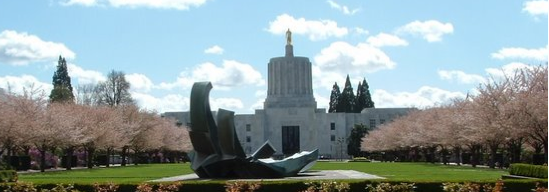
Monday, September 20, 2010

Petition to Stop Letting PGE Profit by Destroying Climate Stability

See the petition gadget to the right, and please sign it!

Fellow Oregonians,

The science is clear and unmistakable: it is no longer reasonable or prudent for PGE or any other utility to burn coal.

We need a change in law so that the Oregon Public Utility Commission is required, as a matter of law, to make that finding -- that coal burning is not reasonable or prudent -- and, therefore, to deny any recovery of costs from ratepayers for any spending on or capital connected with coal use. We need to force the Oregon PUC to refuse any cost recovery for any coal-burning power plants after 2014 and to prohibit Oregon utilities from making any profit on coal-derived power imported from anywhere else.

We also need to increase the rate of return on low-carbon investments so that private utilities have the greatest possible incentives to invest in development and use of these vital energy sources. In addition to requiring the Oregon PUC to refuse any recovery for money spent on anything having to do with the use of coal, the PUC should be mandated to create a bonus rate structure that rewards utilities for conservation investments and for low and carbon-free power that they deliver by giving them a higher rate of return on these sources.

Responding to the climate threat is not just an environmental issue -- future generations can't speak for themselves yet, but they will have to live with the consequences of our actions now, making climate stability the ultimate global human rights issue. Oregon is well-positioned to establish the principles and legal mechanisms for an effective response to this grave danger.

In response, Sen. Peter Courtney forwarded the following from State Treasurer Ted Wheeler:

FOR IMMEDIATE RELEASE Contact: James Sinks
Sept. 20, 2010 503-508-0737 (cell)
James.Sinks@state.or.us


Treasurer Wheeler urges better regulation of coal ash to reduce health risks and lessen need for costly cleanups

As a major investor, Oregon supports responsible corporate practices and sensible regulations


SALEM - Oregon State Treasurer Ted Wheeler is asking the U.S. Environmental Protection Agency to better regulate the disposal of toxic coal ash in order to reduce the likelihood of costly environmental and public health impacts.

The State Treasurer, representing the Oregon Public Employees Retirement Fund, is part of a coalition of institutional investors that collectively manage more than $240 billion in assets and jointly submitted testimony asking the environmental agency to enact stronger rules regarding disposal of coal ash, and better reporting about those methods.

Oregon has one coal-fired power plant and coal ash landfill site, at Boardman in Morrow County. The facility is operated by Portland General Electric, which has announced plans to stop burning coal at the plant by 2020, which would be 20 years ahead of schedule.

"Every corporation and utility should act in a responsible way, especially when they are dealing with toxic wastes," Treasurer Wheeler said. "PGE is taking the right steps for their company, for their shareholders and for Oregon. Wherever coal is burned, investors and the public will be better protected by stronger rules, because doing too little can lead to major costs later."

Coal ash is a by-product of burning coal and contains heavy metals such as arsenic, mercury, lead and other toxins, and is left in landfills or ponds. However, those ponds and landfills are subject to less consistent regulation than landfills accepting household trash.

National attention to coal ash disposal was raised after a pond breach in Tennessee in 2008. That disaster sent millions of gallons of contaminated sludge and water into the Emory River and destroyed three houses.

In its testimony, the investors' coalition highlights the financial assurance requirement in the proposed regulations, saying that provision will help shareholders to understand financial risks associated with coal ash and to evaluate which companies are financially prepared to manage the costs of decommissioning coal ash sludge ponds or dealing with other coal ash-related impacts.

The Oregon State Treasury, which manages the Oregon Public Employees Retirement Fund, directly interacts with companies in an attempt to improve corporate responsibility and to enhance shareholder say in issues such as CEO salaries and reporting of environmental safeguards and risks.

In addition to internal communications and proxy vote actions, Oregon also seeks more accountability from Wall Street and corporations through lawsuits, when companies have failed to act in shareholders' best financial interests.

Good corporate governance is a system of checks and balances that fosters transparency, responsibility, accountability and market integrity - and as a result, adds value to public investments.

Other signatories to the letter to the EPA include the Connecticut State Treasurer's Office and New York State Comptroller Thomas DiNapoli.

The Oregon State Treasury protects public assets and saves Oregonians money through its investment, banking, and debt management functions. The office also promotes public outreach and education to help Oregonians learn strategies to save money, invest for college and make smart financial choices.

###

In honor of today's Rail Now! convention in Salem

Good piece on the logic of making our EXISTING rail system a top priority. Hope the Rail Now! convention spends about 9 times more energy and attention on rebuilding the existing system as the attendees do on pie-in-the-sky high-speed rail ideas. Nothing wrong with the dreamy visions -- unless they divert money from Job 1, which is maintaining and expanding the system we have now, so that, with luck and hard work, we can someday again have a system as good as we had in 1910.

Countries that make makers take back their products are winning

Maria Federici's Story ~                      ...Image by vikisuzan via Flickr

Friedman's column emphasizes the multiple benefits, both predictable and less so, that flow from passing extended producer responsibility (EPR) laws. No reason these laws can't start in Oregon, one of the "laboratories of democracy."

. . . . This is a great opportunity for U.S. clean-tech firms — if we nurture them. "While the U.S. is known for radical innovation, China is better at tweak-ovation." said Liu. Chinese companies are good at making a billion widgets at a penny each but not good at complex system integration or customer service.

We (sort of) have those capabilities. At the World Economic Forum meeting here, I met Mike Biddle, founder of MBA Polymers, which has invented processes for separating plastic from piles of junked computers, appliances and cars and then recycling it into pellets to make new plastic using less than 10 percent of the energy required to make virgin plastic from crude oil. Biddle calls it "above-ground mining." In the last three years, his company has mined 100 million pounds of new plastic from old plastic.

Biddle's seed money was provided mostly by U.S. taxpayers through federal research grants, yet today only his tiny headquarters are in the U.S. His factories are in Austria, China and Britain. "I employ 25 people in California and 250 overseas," he says. His dream is to have a factory in America that would repay all those research grants, but that would require a smart U.S. energy bill. Why?

Americans recycle about 25 percent of their plastic bottles. Most of the rest ends up in landfills or gets shipped to China to be recycled here. Getting people to recycle regularly is a hassle. To overcome that, the European Union, Japan, Taiwan and South Korea — and next year, China — have enacted producer-responsibility laws requiring that anything with a cord or battery — from an electric toothbrush to a laptop to a washing machine — has to be collected and recycled at the manufacturers' cost. That gives Biddle the assured source of raw material he needs at a reasonable price. (Because recyclers now compete in these countries for junk, the cost to the manufacturers for collecting it is steadily falling.)

"I am in the E.U. and China because the above-ground plastic mines are there or are being created there," said Biddle, who just won The Economist magazine's 2010 Innovation Award for energy/environment. "I am not in the U.S. because there aren't sufficient mines."

Biddle had enough money to hire one lobbyist to try to persuade the U.S. Congress to copy the recycling regulations of Europe, Japan and China in our energy bill, but, in the end, there was no bill. So we educated him, we paid for his tech breakthroughs — and now Chinese and European workers will harvest his fruit. Aren't we clever?

Enhanced by Zemanta

Sunday, September 19, 2010

Recognizing libraries as necessities

http://irjci.blogspot.com/2010/09/public-libraries-should-be-necessities.html

. . . This is why the funding of American libraries should be a matter of national security.  Keeping libraries open, giving access to all children to all books is vital to our nation's sovereignty.  For nearly 85 percent of kids living in rural areas, the only place where they have access to technology or books outside the schoolroom is in a public library.  For many urban kids, the only safe haven they have to study or do homework is the public library. Librarians are soldiers in the battle for our place in the world, and in many cases they are getting the least amount of support our communities can offer.

We need to shift our national view of libraries not as luxuries, but as necessities.  When tragedy strikes in other nations, Americans are generous, but our libraries are being hit with a tsunami and there has been no call to action.  Staffs are being fired.  Hours are being cut. Doors are being closed. Buildings are being razed.  Kids are being left behind.  Futures are being destroyed.

Libraries are the backbone of our educational infrastructure, and they are being slowly broken by bankrupt municipalities and apathetic politicians. As voters and taxpayers, we have to demand that our local governments properly prioritize libraries.  As charitable citizens, we must invest in our library down the street so that the generations serviced by that library grow up to be adults who contribute to not just their local communities, but to the world. . . . 

Sadly, Salem is not bucking this trend, with libraries coming well after pavement in terms of funding.  As the Long Emergency continues the unwinding of the middle class, we're likely to discover that cities and towns that don't support libraries are soon run by people who don't use libraries and soon after that by people who don't understand why that matters, and quickly thereafter by the bunko artists who inevitably prey on people who don't understand how important libraries are.

Libraries are the escape valve for the students facing mediocre teachers and test-crazed administrators; the lifeline for the poor who want better for themselves and their children; for the teen who thinks that no one in the history of the universe has ever been so little understood or appreciated; for the unemployed workers who need to start a business and can't afford the advisors to tell them what the rules are; for the homeless who want some stability and a place where they can use the internet to try and keep their connection to the normal world from fraying even further, and, ultimately, libraries are treasure houses for the well-fed, well-employed, well-housed, and well-educated too, because these are exactly the people who use the library the most and who get the most value from the tiny slice of tax revenue that supports it.

Saturday, September 18, 2010

Most Fervent Unsolicited Plug yet: SunWize


Today we signed a deal with SunWize to put 4338 watts of solar panels on the south-facing roof here at LOVESalem HQ. Gross cost $5.48/watt; net installed cost after Energy Trust of Oregon rebates and federal and state tax credits = $1.29/watt, The (conservative) estimate is that the system will provide for 85% of our electric power on an annual basis. I actually expect better because 2009-10 usage included use of two powered devices that we're done with.

I called a bunch of SunWize customers to check them out and every single one really raved about SunWize and the performance they've attained on their systems. Given the upcoming budget issues at both the state and federal level making continuation of these incentives more doubtful every day, this would be a good time to look into solar if you've got the right spot -- contact Matthew Henderson (503.881.7346) and he'll come out and check out your solar resource potential and system possibilities with no pressure.

Friday, September 17, 2010

"Micmacs" at Salem Cinema: A joyous way to kick off MyPeace month

Micmacs (film)Image via WikipediaDon't miss it -- a charming, joyous, exhilarating movie that is, above all, loads of fun.

September 17 - 23
Micmacs
In French with English Subtitles.

Friday 6:00 8:40
Saturday (*12:30) (*3:15) 6:00
Sunday (*12:30) 6:00
Monday (*12:30) 7:40
Tuesday 7:40
Wednesday/Thursday (*5:20)
(*Bargain Shows)
Enhanced by Zemanta

Thursday, September 16, 2010

MyPeace Month starts in the city named for Peace

Imagine The The Peace Ballad of John & YokoImage by Adele McAlear via FlickrQuite a lineup of activities and brainfood events for Oregon Peaceworks' "MyPeace" month:
John Perkins' talk launches the MyPeace Project, a month of events in October featuring artistic visions of peace and sustainability by Oregonians that includes display art, performances, music, dance, poetry-prose, films, lectures, green living classes and tours, ending with a "Peace Shindig" celebration. For schedule of events: (503) 585-2767 or www.mypeaceproject.org.

Here is the full calendar of MyPeace events. Take a moment to enter them into your calendar now! All events are free unless otherwise noted.
  • Sun, Sept. 19: Kites 4 Peace at Bush Park 2-4 pm.
  • Tues, Sept. 21: John Perkins Lecture, Smith Auditorium, WU 7:30 pm.
  • All September-October: "Whirled Peas" Quilts, Greenbaum's.

OCTOBER:
  • 1st, Fri: Art and Mayoral Proclamation, Ladd & Bush Bank Lobby, 12-3 pm.
  • 1st, Fri: Display Art, Coffee House Cafe Gallery 7-10 pm.
  • 2nd, Sat: Solar & Green House Tour at Pringle Creek Community.
  • 6th,Weds: 1st Wednesday: Doors 2 Peace display and Free Hugs downtown.
  • 7th, Thurs: Dances of Universal Peace, Unitarian Universalist Church, 7 pm.
  • 7th: M.C. Mehta, Global Climate Change, Willamette U. law school, 7 pm
  • 8th, Fri: M.C. Mehta, "Ethical and Spiritual Considerations of Going Green," Marco Polo Restaurant. Buffet dinner at 6:30 pm. $30.
  • 8th: Tom Rawson, folksinger, Capitol Manor Comm Ctr, 7 pm. $10-20
  • 9th, Sat: "Living Peacefully," Written Performance Art, Coffee House CafĂ©.
  • 9th: Arts for advocating peace in the public arena workshops, Capital Manor, 9 am - 3 pm.
  • 10th, Sun: Performance Art Presentations - Grand Theatre 2-5 pm.
  • 13th, Weds: Thich Nhat Hanh Mindfulness Peace Celebration, Woodland Chapel at 7 pm.
  • 14th, Thurs: Salem Progressive Film Series: "Soldiers of Peace" - Grand Theater, 7 pm. $3/Students $2.
  • 16th, Thurs: Yoga event, Pringle Creek Community, 8-9:30 am.
  • 16th: "Promoting Peace Through Green Living," Pringle Creek Community, Sustainability Workshops, 9:30-11 am and Bike Clinic 1-5 pm.
  • 21st, Tues: Salem Peace Lecture featuring Fr. John Dear. Mary Stuart Rogers Music Center, Hudson Hall, Willamette University. No charge. 7:30 pm.
  • 22nd, Weds: Dancing with Conflict, Pt. I: Interfaith panel and Peace Visioning exercise, 7 pm, Putnam Center, Willamette University. No charge.
  • 23rd, Thurs: Dancing with Conflict Pt. II: Conflict Resolution skill-building, 8:30 am - 4 pm, Putnam Center, Willamette University, Registration: $10-25 sliding scale.
  • 24th, Fri: Peace Kite Flying on Make a Difference Day, 2-4 pm, Riverfront Park. Music & food provided.
  • 30th, Sat: Peace Shindig, West Salem Masonic Lodge 7-10 pm. (Admission: Adult - $10 or $7 w/ 3 canned goods; Children - $7 or $5 w/ 3 canned goods All canned goods will be donated to Marion-Polk Food Share.)
For more information on any of these events, visit www.bit.ly/mpschedule.
Information is changing daily so if you don't find what you need, please check back in a day or two or call Oregon PeaceWorks at 503-585-2767.
Enhanced by Zemanta

Wednesday, September 15, 2010

Wrong direction in a hurry

As times get harder, access to health care is going to be tougher and tougher to provide. One of the best things you can do for yourself and your loved ones is to be the exception to this scary trend.

Tuesday, September 14, 2010

Rally against the banksters that broke America

Bank of America - Take Back the Economy 4-28-0...Image by seiuhealthcare775nw via Flickr
Please come and support the action, led locally by SEIU, to stand up against Big Bank Greed: for example, high rates of foreclosures in Oregon, exorbitant fees, lost pension funds, all contributed to triggering a downward spiral in our economy and our state budget. This has hurt the lower income individuals most severely and it is time for everyone to stand up to the big banks.

DAY - September 17th Friday

WHERE - Bank of America office, 390 High Street, Salem at corner of Center & High

TIME - 12:00 to 1:00 pm

Join your friends and neighbors in saying "Shame On You" to big banks!
More info on ways to move your money so that you're not investing in the third-worlding of America. Credit unions are your best bet, and Salem is blessed with some good ones.
Enhanced by Zemanta

Monday, September 13, 2010

Another must read: Bob Hirsch interview

New presentation of data in figure 20 of http:...Image via WikipediaGuest Post by Steve Andrews

Robert L. Hirsch, Roger Bezdek and Robert Wendling have coauthored a new publication, this time a book called “The Impending World Energy Mess: What It Is and What It Means to You,” a book to be released by publisher Apogee Prime late this month.

Andrews: In your earlier work dating back at least five years, you resisted forecasting a time frame for peak oil. There seems to be a bit of a change on that front in your book. Care to comment on that?

Bob Hirsch: In years past, there was considerable uncertainty in my mind about when the decline of world oil production might begin. Recently it became clear to me that it’s going to be sooner rather than later. I believe that the onset of the decline of world oil production is likely in the next two to five years. And when I say “oil,” I mean all liquid fuels.

Andrews: You say that once declining oil supplies hits, we’re likely to experience deepening worldwide economic damage. How is that likely to unfold? What is your most likely scenario?

Hirsch: Our thinking is that what happened in the two sudden oil shocks of 1973 and 1979 is very likely to be repeated when oil decline sets in. Those were two real world examples of oil shocks surprising people and causing panic. We believe that the same kind of thing is going to happen again, except that the problem is going to last much, much longer because, unlike before, there will be no unused oil supply valves to turn on this time.

While economies have changed since the 1970s, the dependence on and importance of liquid fuels has not. And human nature hasn’t changed. People panic when they get suddenly frightened. Even though -peak oil‖ is recognized by a number of people, it is yet to be realized on a wide scale.

In the book we avoided consideration of such things as anarchy, wars, and other catastrophes that are conceivable. We see very little chance that things will be any better than what we describe, but things could easily be worse.

By the same token, we have faith that humankind is not going to collapse because of the oil decline problem. The world is in for considerable pain for a long time. Nevertheless, we have great faith in human resilience. People will come around, get very pragmatic, dig in and do what’s necessary to meet the challenges. As a result, when we get through all of this-which is going to take longer than a decade-the societies that emerge are going to be much stronger and much more pragmatic than they are today.

Andrews: You note that there will be no quick fixes. What mix of crash programs are you currently recommending as the focus of any accelerated policy efforts today?

Hirsch: We sketch practical, physical mitigation options for the world. They are the ones we described in 2005, plus or minus a few changes due to our being a little smarter now in some areas. In the book, we added what we call “administrative mitigation,” such as forced carpooling, forced telecommuting, and rationing. There is benefit to be gained from those options, but their implementation will not be simple.

For instance, rationing seems like a relatively simple concept but after one considers the details, it is incredibly complicated due to decisions that have to be made, the bureaucracies that have to be built, and the enforcement that has to be implemented. Understanding the complexities is necessary for practical decision-making. . . .


Robert L. Hirsch, Roger Bezdek and Robert Wendling have coauthored a new publication, this time a book called “The Impending World Energy Mess: What It Is and What It Means to You,” a book to be released by publisher Apogee Prime late this month. Hirsch will present material from his upcoming book at the October 7-9 ASPO-USA conference. Please see the full agenda for details at aspousa.org. He has spent his entire career working in the energy realm, from the oil sector to numerous forms of electric power generation. In 2005, this team published “The Peaking of World Oil Production: Impacts, Mitigation & Risk Management.” Steve Andrews caught up with Bob Hirsch last week for Steve’s last interview and final work with the Peak Oil Review. (Steve co-established the Peak Oil Review the Tom Whipple some 243 issues ago in January 2006 and has both enjoyed and enormously appreciated a very close collaboration with Tom for nearly five years; Steve is now moving on to other endeavors.)

Enhanced by Zemanta