http://www.energybulletin.net/stories/2012-05-31/goodbye-bad-knowledge
The other major system crash that's coming, besides education, is in our sickness care "system," which is shot through and through with total dependency on economic growth fueled by the now-gone cheap energy.
In one sense, the end of cheap energy will mean better overall health. America's obesity epidemic is really just a marker of how many energy slaves we all command. Now that the once-per-planetary-lifetime cheap energy extravaganza is drawing to a close, so too will we see the end of the bad habits it produced, which all boil down to having machines do everything for us.
BUT, there's a very rough transition ahead between now, when we have a huge overhang of people with bodies made sick by decades of dietary mistreatment and avoidance of exercise, and our future, when we won't be able to afford a sickness care system that continually spends a huge fraction of its total budget on people in their waning days, which ignoring the basic health needs of a giant and growing underclass of people.
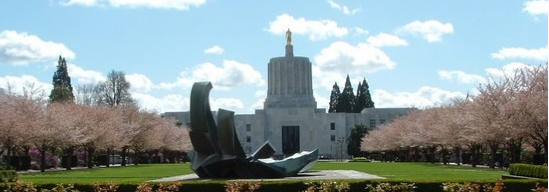
Ultimately we are going to have to recognize that organizing access to health care through employment is a gigantic blunder, and that allowing the entire sickness care system to be structured around the profit motive is a recipe not just for lots more sickness and lots more profits, but essentially for making America a third-world country. Given that Salem Hospital is laying off skilled workers even as people in Salem are increasingly shut out of affordable health care, the contradictions built into the system are soon going to be too great to ignore.
Showing posts with label Health Effects of Sprawl. Show all posts
Showing posts with label Health Effects of Sprawl. Show all posts
Thursday, June 7, 2012


Tuesday, May 8, 2012
The losing game
The one thing we should NOT be doing is buidling more autosprawl . . .
NY Times's Frank Bruni:What if we have it backward? What if the 310-pound man trying to jam into the middle seat and the 225-pound woman breaking into a sweat only halfway up the stairs aren't the undisciplined miscreants of modern American life but the very emblems of it?What if fatness, even obesity, is less a lurking danger than a likely destiny, and the surprise isn't how many seriously overweight people are out there but how few? . . .
Following in the heavy footsteps of "The Omnivore's Dilemma," "The End of Overeating," "The End of Food" and much else, "The Weight of the Nation" makes an especially persuasive case that gluttony isn't Americans' problem. Agriculture and abundance are.
Over the last century, we became expert at the mass production of crops like corn, soybeans and wheat — a positive development, for the most part.
We also became expert at feedlots for livestock and at processing those crops into salty, sweet, fatty, cheap and addictive seductions. This has downsides.
Densely caloric and all too convenient food now envelops us, and many of us do what we're chromosomally hard-wired to, thanks to millenniums of feast-and-famine cycles. We devour it, creating plump savings accounts of excess energy, sometimes known as love handles, for an imagined future shortage that, in America today, doesn't come. . . .
John Hoffman, an executive producer of the documentary, told me: "Evolutionarily, there was no condition that existed when we were living with too much fat storage. We've only known a world of plenty for maybe 100 years. Our biological systems haven't adapted to it."
This is probably summed up best by Michael L. Power and Jay Schulkin in their book "The Evolution of Obesity." "We evolved on the savannahs of Africa," they write. "We now live in Candyland."
Our systems aren't just rigged to gorge. They're also rigged in many cases to rebound from weight loss and put pounds back on, as Tara Parker-Pope explained in a cover story for The Times's Sunday magazine last year. So we're fighting againstthat bit of nature, too. . . .If we're going to wage a successful war against unhealthy weight gain and obesity, we need to understand all of that. We need to stop vilifying obese people, who aren't likely to be helped by it
And we need to rethink and remake our environment much more thoroughly than we seem poised to do.
The kind of consciousness-raising and corporate prodding being done by Michelle Obama — laudable as it is — won't be nearly enough. Neither will the extra green space for exercise that cities like Nashville have commendably created, or New York City officials' admirable exile of sugary sodas from public school vending machines.
These important steps, plus others under consideration, are just the start. Let's move, yes. But let's do it a whole lot faster, because what we may be trying to hold back is a near inevitable tide.
Friday, September 2, 2011
Saturday, April 9, 2011
Does auto exhaust cause brain damage? Study suggests it might
 Image by Simone Ramella via FlickrThis is an example of where the precautionary principle would be helpful -- there's some evidence of the possibility of serious harm from an industrial activity, but what will happen now is that it will take a long time for the evidence to solidify, particularly in light of the typical denial-evasion-obfuscation-retaliation cycle from the affected intere$t$.
 What ought to happen, in these legacy cases where the activity got underway well before the science of risk assessment developed, is that the developing mosaic of suggestive studies should cause the onus to shift onto the activity ... in other words, instead of having to prove to the satisfaction of the affected industry that there is a sufficient quantum of proof to justify a serious response (which typically only happens after decades of the profit-making companies fighting against science like trapped rats), the industry ought to now have the burden of producing, within say five years, solid and valid disconfirming evidence or face a regulatory action aimed at eliminating the chance that the hazard is there.

Wednesday, September 15, 2010
Wrong direction in a hurry
As times get harder, access to health care is going to be tougher and tougher to provide. One of the best things you can do for yourself and your loved ones is to be the exception to this scary trend.
Thursday, December 10, 2009
Presented for your consideration

Or will the Salem/ODOT Road Gang continue to pretend that you can do an environmental assessment of a proposed project (one that will greatly increase greenhouse gas emissions) without looking at greenhouse gas emissions, even though the Environmental Protection Agency has finally acknowledged that they are a hazard to public health?
![Reblog this post [with Zemanta]](https://lh3.googleusercontent.com/blogger_img_proxy/AEn0k_sIFQYyFiRoE-mOYKLpGRRQwdGuwZfayyQrNUjBkXQRgDOXtVN36FQXgklE_9DK_0XB53k5puwXOJJwnZHymHBqpXohOM69TCzjCGiBtzR3Y0GD_20Sse0fCWTgnv6OynK9HrlxtwJXuwpCBwugrno=s0-d)
Wednesday, October 28, 2009
As energy costs break city and state budgets, public health costs set to soar

Alas, nearly every one of the failures to prepare listed below applies to Salem, where officials are busily pretending that we can continue sprawling, flying, and driving like it was 1959 and that there's no need to be concerned about local food resiliency or helping people learn to be more food secure.
Ailing planet seen as bad for human health
Climate change will make Americans more vulnerable to diseases, disasters and heat waves, but governments have done little to plan for the added burden on the health system, according to a new study by a nonprofit group.The study, released Monday by the Trust for America's Health, an advocacy group focused on disease prevention, examines the public-health implications of climate change. In addition to pushing up sea levels and shrinking Arctic ice, the report says, a warming planet is likely to leave more people sick, short of breath or underfed.
Experts involved with the study said that these threats might be reduced if the federal government adopts a cap on greenhouse-gas emissions. But no legislation could stop them altogether, they said. Emissions already in the atmosphere are expected to increase warming -- and the problems that come with it -- for years to come.
"That [a cap on greenhouse gases] really is not enough," said Phyllis Cuttino of the Pew Environment Group, which funded the study. "We can see all these problems coming, but as a country, we haven't done enough to prepare for them."
The idea that climate change will be bad for people as well as polar bears is not new: It was explained in detail by a United Nations panel that won the Nobel Peace Prize for its work on climate in 2007.
Monday's report summarized some of the biggest worries for Americans in particular. They included:
-- Heat waves, which the report says are expected to increase. The danger is expected to be worst, the report said, in concrete-clad cities, where the lack of greenery creates an "urban heat island." Under climate change, the experts said, summer heat could also sneak up on people in cities where air conditioning hasn't been needed in the past.
-- More "extreme weather events," such as hurricanes, floods and wildfire-breeding droughts. Drought could also create crop failures, the report said, leading to malnutrition.
-- More widespread diseases carried by mosquitoes, ticks and other pests. If warmer temperatures allow these animals to expand their ranges northward, the result could be more cases of West Nile virus, Lyme disease and hantavirus.
-- Increased air pollution, caused because heat contributes to the formation of smog. This, the report said, could increase the incidence of severe asthma or pulmonary disease.
The experts who worked on the study said they could not provide a timetable for when and where these effects will appear. But they said it is already time to get ready for them, but many governments are not doing so.
"Some of the most personal effects of climate change are going to be health-related ones," said Jeff Levi, executive director of the Trust for America's Health. "We should want the government doing as much as possible now to prevent these effects, or minimize them when they occur."
![Reblog this post [with Zemanta]](https://lh3.googleusercontent.com/blogger_img_proxy/AEn0k_tykF0h7W3dQtqwt1xUagjCEjcl8BUT_QIUYqXLnuhlnjzpXVa1BK9JyTZWAx31BXX955bh3dRGmxTqLz0901UoebjMkibVA_w2qrUP8iaKuvjtTg7Db7n9dZ_lOX9GfrB001g5KFDxyntQvow0H04=s0-d)
Wednesday, October 14, 2009
Salem Council makes choices: Increase obesity and diabetes

Salem is becoming ever more hostile to pedestrians and bicyclists. In just the past couple years alone, the city has
- Abandoned its responsibilities for sidewalks, leaving miles of them in terrible condition with huge gaps and gigantic discontinuities that make them all-but-impassable for wheelchairs and dangerous to walkers and people with children in strollers;
- Put all its efforts into maintaining and expanding roads for cars and coveting yet more asphalt for autos such as a third bridge over the Willamette;
- Regularly putting the convenience and pleasure of car drivers ahead of the needs of pedestrians and bicyclists, such as the recent privatization-in-all-but-name of the railroad crossing that connected State Street with Riverfront Park. The Council has decided to give that crossing to a developer and force pedestrians to walk well out of their way south and then north again to reach the Carousel . . . but hey, it adds more parking for the Carousel, so it's a good deal, right?!
UPDATE: It's not like we don't know any better. We could learn from examples like this:
Minn. city's get-healthy effort called a successFitness project adds years to lives of Albert Lea residents, organizers say
. . . The 69-year-old's radical lifestyle change came as part of the "Vitality Project," an endeavor spearheaded by AARP and United Health Foundation that organizers say has added several years to the lives of Albert Lea residents through improved diet, exercise and living habits.With organizers' help, the city crammed five years of sidewalk and bike trail construction into a year to make exercise easier for its 18,000 residents. Restaurants added healthier menu options and grocery stores showcased wholesome foods. People snacked on fruits and veggies and ate less fast food.
Schools stopped celebrating birthdays with sugary treats and started setting up "walking buses" that allowed kids to walk to and from school together with adult supervision. Employers gave workers time to exercise.
Organizers say the first-of-its kind experiment added an average 3.1 years to the longevity of about 2,300 residents who calculated their lifespans by answering 36 lifestyle questions dubbed the "vitality compass."
. . . Mayor Mike Murtaugh said the city had little expense other than some staff time. . . . "A lot of health professionals are buying into the idea that this is a problem we're going to have to tackle in a lot of different ways," Nelson said. "This idea of a community approach is something a lot of people are really getting excited about."Outside Lakeview Elementary on Tuesday afternoon, adults shepherded a large group of children headed home in a "walking bus."
Judy Dilling, 60, was escorting her two grandchildren the mile to their house, which didn't happen before the project. Dilling also has joined a group dubbed the "Walkie Talkies" and now walks the mile-and-a-half home from her part-time job instead of driving.
"It's invigorating," she said. . . .
Tuesday, October 6, 2009
Don't mind all the unnecessary deaths!
To help you avoid dealing with reality, just keep repeating the GOP and Blue Dog Democrat's mantra: "We have the finest health care system in the world. Insurance companies care about us. We have the finest health . . . " And for God's sake, don't look at the facts.
Wednesday, August 26, 2009
Think health care costs a lot now?

Think health costs are hot now? Factor in global warming
A report by University College London and The Lancet, a leading public health journal, recently called global warming the greatest threat to public health this century. As I described in a June 21 column, the report said climate change will produce worsening patterns of vector and waterborne disease; heat and respiratory illnesses; malnutrition; and harm from extreme weather events, flooding and sea level rise. Billions of people in both developed and developing nations will be affected.
In Oregon, for instance, asthma is already a major problem, and it will expand as temperatures increase. Heat-related illnesses will grow as we experience more frequent periods of 100-degree days. West Nile Virus, which is caused by infected mosquitoes that migrate northward as temperatures warm, has appeared here and eventually could spread as it has in other states.
The costs of health care are certain to skyrocket under these conditions. A study produced in February by my program at the University of Oregon, for example, found that global warming would generate a minimum of $764 million in additional health-related costs for Oregonians by 2020.
These costs are likely to increase to at least $1.3 billion by 2040. Other states will experience even higher costs. Employers and the self-insured will find it exceedingly difficult to pay the additional costs of climate-induced health impacts. Further, unless every American is automatically covered, those most affected by the health impacts of climate change — including the infirm, children, elderly and low-income individuals — will be left to fend for themselves. . . .
The media has done a good job of documenting the disinformation and consequent hysteria generated by opponents to health care reform. Less well-documented are the remarkably similar strategies being used to stop climate policies. A good example is a two-inch-thick document I recently received from a journalist friend, published by a right-wing group. It claimed to refute the science of today's global warming.
If it weren't so frightening, it would be laughable. Millions of dollars undoubtedly were spent on the publication. It has a glossy cover, is made to look like a report from the Intergovernmental Panel on Climate Change, and almost certainly was mailed to hundreds of reporters — and probably others — nationwide.
But rather than being filled with peer reviewed science, it is laced with anti- government and environmental rhetoric. Most of the claims it makes to refute the fact that the Earth is warming primarily due to human activity are irrelevant. It cherry picks data to make its case and omits other important data. Many of the key points are nonsensical. The credibility of the document, however, does not matter. The goal is to create doubt among the unsuspecting about the veracity of global warming and thus stifle support for climate protection policies.
There is too much at stake now to let this type of cynical behavior rule the day. . . .
Bob Doppelt is director of Resource Innovations and the Climate Leadership Initiative at the University of Oregon.
(And here's a link to another sobering piece very much worth reading.)
![Reblog this post [with Zemanta]](https://lh3.googleusercontent.com/blogger_img_proxy/AEn0k_vEIGn7PwAQ-irkk8J1lsb92g7R90fzbpIknPGuWcMDezbwNM1YDpKo9XCAT-qmgk9ziB4UnIE-H0AOJ7vS7RqMplpoIoBjZpqHQLa7Q3Xvmpq3YuHLzgf3WiIPbRAqnwNHWNrUyQoATCVNI25kDnY=s0-d)
Monday, July 13, 2009
We're killing each other with cars
InvestigateWest has a concise piece that sums it up:
Another reminder that we've got to get Oregon-ized to put the needs of people ahead of cars. It's a matter of life and death.We’re killing our neighbors with our cars
We are literally killing people with air pollution.
It’s a simple fact that tends to get forgotten in the everyday bustle of our lives. And it’s that bustle itself – specifically, zipping to and fro courtesy the internal-combustion engine – that is proving most difficult for air-pollution regulators to fight.
Photo/Flickr and icewaterdog
These points are brought out nicely in a story by Keith Matheny that ran Sunday in The Desert Sun, the newspaper in Palm Springs, Calif. Thousands of people die from air pollution each year there in the Coachella Valley alone.Now, it’s true that Palm Springs is cursed with unfortunate geography of being just over a low pass from Los Angeles, and located in a bowl of a valley. So the gunk in the air from LA and western Riverside County becomes a problem for Palm Springs.
But it’s also true that you could find many places in this country where air pollution peaks to levels considered too high for breathing. Matheny explains:
It’s the mobile pollution sources — diesel trucks, construction equipment, cars, trains and planes — that pose the biggest air quality challenges.
He goes on to point out, though, that the California Air Resources Board has just 50 inspectors to target a state’s worth of vehicles. . . .

Thursday, June 25, 2009
Car Exhaust -- or Poverty? Can the two be separated?

Although that's a problem from a scientific point-of-view, it's not much of a practical difference, because there is one thing that is true in every city in America: it's the poor who get to live near the busy roads, thick with autosmog. Bad air quality from car and truck exhaust is something that we carefully protect wealthy neighborhoods from.
Just like with the proposed "Salem River Crossing." The object with this boondoggle is provide an even greater subsidy for driving to the wealthy, mainly white commuters in Polk County and beyond by giving them yet more lane miles ---although at the cost of carving a huge chunk out of several NE Salem neighborhoods and turning them into blast zones for a torrent of cars that will zip through, leaving only pollutants, the occasional hubcap, and the odd maimed pedestrian behind. Nobody in ODOT or any of the local governments give a rip about the people in NE Salem, many of whom are Hispanic -- perfect targets, in other words, for yet another sprawl project built atop the homes of the poor, as is the American way.
![Reblog this post [with Zemanta]](https://lh3.googleusercontent.com/blogger_img_proxy/AEn0k_uRLzyuB6BLhFpu2IDKYex2QNdv-3KCc3r14R2QJMaeEKoEdULkJSDq9CD0ZpcWxNZbumuaqpiptm2U8T5FUkoR-jaODfafSNmPYOCGzHofQ5fR3giUPNjIbyeR0OX21-xE85b8CKY4qMZUhMQvnKoq=s0-d)
Thursday, June 4, 2009
Soot (such as from diesels) even worse than we thought

![Reblog this post [with Zemanta]](https://lh3.googleusercontent.com/blogger_img_proxy/AEn0k_vS6sP7cdxIY-FsX1q06h-WnN6NYXrAgBSMNrZBGcHlNYlBxB98lQ2GDQvOR1wP5O8iddK3fKNPY1A1fAbGvaR8Gr9G7hy3AEE-P6Rz2Zfhe6bcvB-w6z3JhyseMGw-EuhhK-eAPgtaFjqrPkF1qziZ=s0-d)
Tuesday, April 7, 2009
Memo to Salem's Downtown Redevelopment folks
You're doing it wrong. The only groceries available near all Salem's new condos and apartments are beer and cigarettes. As a public health matter, Salem needs to focus on bringing a greengrocer downtown. We subsidize parking for cars like crazy, building them entire multi-story buildings. Why shouldn't we take some of that money and spend it on improving public health instead?
VICTORIA — Want to lose weight? Move closer to a grocery store.
A new study from the University of British Columbia shows people who live within a kilometre of a grocery store are half as likely to be overweight, compared to those living in neighbourhoods without grocery stores.
The study shows that old-style urban planning that mixes retail with residential zones gets people out of their cars, onto the sidewalks, and helps them keep their weight down.
And if one grocery store is good, two or more is even better, the report released Monday showed.
Researchers found that every additional store within a kilometre translated into an 11 per cent reduction in the likelihood of being overweight.
"People have to access food," said study author Lawrence Frank. "It's a marker for other commercial uses, as well, so it's not just grocery stores that matter."
About 620 people over the age of 15 participated in the study: 576 from the Lower Mainland and 131 from Vancouver Island.
The study measured physical activity and body mass, along with proximity to retail and commercial buildings.
The research found that people walked more often when they lived in neighbourhoods with good street lighting, continuous sidewalks, and a variety of shops, services, schools, parks and workplaces within walking distance.
The study also linked body mass to urban design, showing that people who live in suburb-style neighbourhoods that force them to drive to the store makes them more likely to be overweight.
"None of this is new," Frank said. "What is new is we have a better understanding of how much (urban-development patterns) are affecting us, and the results support more of the traditional approach to building communities."
The study found that people whose neighbourhoods includes stores that front directly onto a sidewalk — rather than those where a parking lot separates the store from the sidewalk — were half as likely to be overweight as those living in neighbourhoods without sidewalk-front stores.
"People don't like walking through a sea of cars," Frank said. "It's not a friendly space."
Wednesday, April 1, 2009
Another great Straub event: Leave No Child Inside
Working Together to “Leave No Child Inside”
7 p.m. Thursday, April 23 Loucks Auditorium
The “Leave No Child Inside” campaign is seeking to reverse alarming trends in children’s activities and reconnect children with nature. Presenter Martin LeBlanc will talk about the campaign and give examples of how communities are working to give their children outdoor experiences.
Martin LeBlanc is the National Youth Education Director for the Sierra Club. He is a founding member and vice president of the Children and Nature Network and is responsible for building the youth leadership with the “Leave No Child Inside” campaign.
LeBlanc was an at-risk youth who had his life turned around through an outdoor experience as a teenager. He worked as an outdoor educator with at-risk youth in Seattle, Washington and served as recreation advocate for Texas Parks and Wildlife in Austin, Texas. He serves on numerous advisory committees related to environmental education.
The presentation is free and open to the public through support from the Charla Richards-Kreitzberg Charitable Foundation, the William S. Walton Charitable Trust, Salem Public Library, City of Salem, and Marion Soil and Water Conservation District. For more information, contact the Friends of Straub Environmental Learning Center at 503-391-4145 or visit www.fselc.org.
The Friends of Straub Environmental Learning Center is a Salem-based, nonprofit organization dedicated to environmental education.
Monday, March 16, 2009
A systemic preference for treating symptoms only
The most frustrating thing about this article that warns parents that their kids are likely getting gassed with dangerous diesel exhaust every schoolday is that the only solution contemplated is a technological retrofit to the buses, rather than the elimination of the need to ferry kids about in buses every day.
Not only is school busing a direct health hazard, but it's also an indirect health hazard as the obesity epidemic balloons among school-age kids. And that's leaving aside the diminished future that kids are going to suffer because we spend so much money on motor transport rather than on education. Even as the public transit system starves and is withering away, contracting and becoming less useful, we maintain a huge fleet of buses that only serve to provide trips that the kids should be making on foot and on bikes.
Worse, when you get into the situation further, you find that district administrators organize the entire district around this bus fleet. Try suggesting a sensible idea like opening high schools much later in the morning (consistent with all research on teens and sleep) and you'll quickly find that "you can't get there from here" because all ideas are evaluated not for their educational effect but for their effect on the scheduling of the buses.
Not only is school busing a direct health hazard, but it's also an indirect health hazard as the obesity epidemic balloons among school-age kids. And that's leaving aside the diminished future that kids are going to suffer because we spend so much money on motor transport rather than on education. Even as the public transit system starves and is withering away, contracting and becoming less useful, we maintain a huge fleet of buses that only serve to provide trips that the kids should be making on foot and on bikes.
Worse, when you get into the situation further, you find that district administrators organize the entire district around this bus fleet. Try suggesting a sensible idea like opening high schools much later in the morning (consistent with all research on teens and sleep) and you'll quickly find that "you can't get there from here" because all ideas are evaluated not for their educational effect but for their effect on the scheduling of the buses.
Saturday, February 21, 2009
The Great God Auto Threatens Your Children
This is what building a society around cars produces --- note that the typically bureaucratic response suggests that the problem is caused by parents or not giving enough money to the medical-industrial complex. The Sprawl Machine doesn't just produce ugly places that will be impossible to use as energy becomes scarce and expensive -- it also hurts children, who are becoming crippled and debilitated by our development patterns that make walking and biking rare activities instead of everyday acts of a healthy young person.
Initiative Takes Aim At Obesity In Children
A coalition of health groups and insurance companies yesterday unveiled an initiative, billed as the first of its kind, to help battle one of the nation's biggest health problems: childhood obesity.Officials of the Alliance for a Healthier Generation, a joint effort of the American Heart Association and the William J. Clinton Foundation, said the initiative is designed to give children better access to health care to fight obesity. Participating insurance companies would pay for at least four visits to a dietitian and four visits to a physician each year to provide guidance to children and their parents on how to eat better and take other steps to reduce and control their weight.
More than one-third of children in the United States are overweight or obese, raising fears that they could constitute the first generation in recent history to have shorter life spans than their parents. One of the biggest problems many families face in fighting obesity is getting insurance companies to pay for doctor visits and other care to help deal with the problem. . . .
Thursday, January 8, 2009
Gas Tax vs. Mileage Tax?
An Oregon enviro poohbah sent out this query:
I've started several times to respond with cogent analysis and keen insights about the pros and cons of gas tax vs. mileage taxes ...http://www.blueoregon.com/2009/01/of-mileage-and.htmlOf Mileage and Gas Taxes
I was pondering the question of the Governor's proposed mileage tax yesterday while listening to the rebroadcast of Think Out Loud. Because they are both related, the mileage and gas taxes are often discussed together. But, based on my pidgin economics, learned mostly on blogs, this seemed backward. Shouldn't you first ask what you're paying for and what behavior you want to promote? So I went to a econ blog and lo, the blogger was asking the same thing:
If you are proposing Pigovian taxes, then both make sense but address very different things. Driving a car imposes external costs through the impact on the environment, through the wear and tear on the roads and through the time cost of congestion.
A mileage tax addresses the wear and tear issue. People who drive will be assessed a tax that is equivalent to the cost of the road wear they are responsible for.... The gas tax is Pigovian in addressing the environmental impact of the amount of carbon emitted which is exactly related to the gas used.
It is clear that each tax is also a poor way to address the other issue, to wit: a gas tax is not a good way to address wear and tear because a Prius could do a lot of wear and tear with little gas and a Mustang could do little wear and tear with a lot of gas; and a mileage tax doesn't work, for the very same reason, as a way to address environmental impact.But even if you're clear which about objective you're targeting, there are other ramifications. Take the mileage tax. People are innately queasy about having a government agency tracking their car--and reasonably so. What happens to this info? Who controls it and who can access it? Another feature of this proposal involves taxing you more for driving during rush hours or in congested traffic. Is this a reasonable penalty for people who already feel penalized by being stuck in traffic in the first place? Presumably, they'd avoid the congestion if it was avoidable. What behavior do you hope to incentivize here?
The gas tax, which is less complex, nevertheless has complications. On the green side of the ledger, it's a no-brainer. It acts as an incentive for people to drive more fuel-efficient cars or drive less. It penalizes those who use gas-guzzlers proportionately. But on other sides of the ledger, it's not so great. As lower-income people are forced further outside of the city core, transportation costs are borne disproportionatley by them. And it effectively amounts to a tax on rural residents who have no access to public transporation. It's true that the correlation between carbon production and taxes are directly relational, but again, are you penalizing people who can't change their behavior?
Hmmm. Your thoughts?
But I end up stopping because this whole discussion ignores the elephant -- heck, the blue whale -- in the driveway.
Somehow we've gotten snookered into having a discussion about how to get drivers to pump more money into pavement (or maintain the amount that they are pumping into pavement) without discussing the fact that the impetus for the whole thing --- the fact that fuel taxes only pay a small (and declining) share of what we're spending on roads --- means that we're sitting around spending all this energy discussing the smallest portion of the problem, rather than the largest part (the general funds and property tax millages spent on roads).
Before we discuss fuel taxes vs. mileage taxes vs. congestion pricing or whatever, we FIRST must resolve to do what so many Oregonians mistakenly think we already do: pay for roads with gas taxes (or their user-fee equivalents, mileage taxes/congestion pricing, vehicle excise taxes, etc.).
In other words, FIRST we must take general fund and property tax millages out of the equation -- eliminate these taxes. THEN we can have the good discussion about how best to allocate the cost of roads across the fees and taxes that come from road users (gas tax, mileage tax, congestion pricing, registration fees, vehicle excise tax and weight taxes). We can talk about adding fees for non-motorized vehicles (bicyclists) as well, such as the clever idea that all vehicles should be registered annually, with the fee based on weight.
Instead, somehow, Oregon environmental groups have decided to help preserve and extend the auto-dominated system by helping finagle more money for roads, instead of fighting to shift road funding onto road users.
And it's not true that people who don't drive should pay property taxes for roads or else they get an unearned benefit ("free rider"). People who don't themselves drive on roads pay their share of roadway fees/taxes through the prices of the goods and services they use. As we shift the costs of roads ONTO the roads -- rather than onto houses, farms, nursing homes, apartment complexes, and other property tax sources -- then we'll see shifts in the costs of goods and services that reflect the amount of transport that they require ... which should be the goal of any environmentalist (get the prices right) as well as any politician (cut general property taxes).
So while the ins and outs of gas taxes vs. mileage taxes can be fascinating sociologically and politically, the real answer is "Sorry, wrong question."
The right question is how fast we can cut taxes and millages that DON'T derive from road uses and how soon we can get to zero; on the way, we can have lots of good discussions about how to make up that revenue with the various use-based fees ...
Sunday, December 28, 2008
Uh-oh ...
"Massive surge in municipal bankruptcies" forecast.
Consider: "Massive snowfall weighs heavy on Salem budget" --- a story, essentially, about how our total focus on automobility threatens to bring us to ruin if --- if you can imagine such a thing --- winter brings snow and ice!
Winter is just another place where general fund monies get sucked into the black hole of sprawl, putting the lie to the fiction that "gas taxes pay for roads." Because Salem is so sprawling, we have a huge road footprint that spreads people out, which means that they have to use cars to get anywhere, which requires spreading people even further apart (to provide room for all the parking). We are already millions in the hole for next city budget, even before the recent unpleasantness with the weather.
Consider: "Massive snowfall weighs heavy on Salem budget" --- a story, essentially, about how our total focus on automobility threatens to bring us to ruin if --- if you can imagine such a thing --- winter brings snow and ice!
Winter is just another place where general fund monies get sucked into the black hole of sprawl, putting the lie to the fiction that "gas taxes pay for roads." Because Salem is so sprawling, we have a huge road footprint that spreads people out, which means that they have to use cars to get anywhere, which requires spreading people even further apart (to provide room for all the parking). We are already millions in the hole for next city budget, even before the recent unpleasantness with the weather.
Monday, December 15, 2008
More on health and driving ourselves into the grave
WaPo has a story today about the health consequences of places like Salem and Oregon having massively funded bureaucracies dedicated to the vision of more roadways and "roadway performance standards" that drive even more road construction projects in a perfect spiral of futility:
New research illustrates the health benefits of regular biking, walking or taking public transportation to work, school or shopping. Researchers found a link between "active transportation" and less obesity in 17 industrialized countries across Europe, North America and Australia.
"Countries with the highest levels of active transportation generally had the lowest obesity rates," authors David Bassett of the University of Tennessee and John Pucher of Rutgers University conclude.
Americans, with the highest rate of obesity, were the least likely to walk, cycle or take mass transit, according to the study in a recent issue of the Journal of Physical Activity and Health. The study relied on each country's own travel and health data.
Subscribe to:
Posts (Atom)

 Posts
Posts


