Thankfully, Oregon PeaceWorks is helping to promote a new crack at this vital idea under the name Transition Town Salem. They're planning an organizing meeting for February 13 at the PeaceWorks office, second floor. Contact PeaceWorks for details.
Showing posts with label Peak Oil. Show all posts
Sunday, January 13, 2013
Speaking of learning vital skills for the future: Transition Town Salem organizing!
Some of you may recall the Salem Transition Initiative for Relocalization (STIR), which attracted some interest for a while three or four years ago, but never really jelled.
Thankfully, Oregon PeaceWorks is helping to promote a new crack at this vital idea under the name Transition Town Salem. They're planning an organizing meeting for February 13 at the PeaceWorks office, second floor. Contact PeaceWorks for details.
Transition Towns are communities working to build resilience in response to peak oil, climate change, and economic instability. OPW seeks to work with environmentalists, economists, city planners, government representatives and members of the public to develop both a plan and hands-on projects that will demonstrate the elements of resilience and sustainability to the Salem, OR community. We are looking for like-minded individuals, especially those with relevant expertise, in developing this program. We also seek to network with as many existing sustainability projects in the Mid-Willamette Valley as possible.

Thankfully, Oregon PeaceWorks is helping to promote a new crack at this vital idea under the name Transition Town Salem. They're planning an organizing meeting for February 13 at the PeaceWorks office, second floor. Contact PeaceWorks for details.
Our Mission:
To educate and activate people to work for peace, justice and environmental sustainability.
104 Commercial St. NE Salem, Oregon 97301
Phone: 503-585-2767 Fax: 503-588-0088.
TTS ( boy, I still prefer STIR ... just call it Salem Transition Initiative for Resiliency if you want to include that important theme ... But hey, a rose by any other name ....) will be holding an organizing meeting at PeaceWorks on February 13
Saturday, September 1, 2012
Tuesday, July 10, 2012
Tuesday, June 26, 2012
GRIM but important - ClubOrlov: Fragility and Collapse: Slowly at first, then all at once
http://cluborlov.blogspot.com/2012/06/fragility-and-collapse-slowly-at-first.html
I wish I could find obvious holes in this. Meanwhile, Salem is blowing millions planning for an absurd multi-hundred million dollar highway bridge to handle the traffic demand of the hypothetical future that exists only in dreams of business as usual with cheap gas and more suburban sprawl.
Friday, June 8, 2012
Oil addiction generates denial | Energy Bulletin
http://www.energybulletin.net/stories/2012-05-25/oil-addiction-generates-denial
A choice bit:
A choice bit:
Little time left to deal with our addiction
Rising gasoline prices should ideally be welcomed as a warning of what is soon to come. One of the keenest observers of the geopolitics of oil and the precarious nature of our U.S. oil dependence is Michael Klare.
Because the American economy is so closely tied to oil, it is especially vulnerable to oil’s growing scarcity, price volatility, and the relative paucity of its suppliers. Consider this: at present, the United States obtains about 40% of its total energy supply from oil, far more than any other major economic power.We will now have to prepare for major economic changes and high gas prices. Oil and politically sensitive gasoline prices have receded in price the last month, but this is in no way a sign that our lives can return to the cheap oil era of the past. We are busily preparing to fight Iran. The energy wars are heating up globally . The hour is getting late.
Klare now calls on Obama to be honest about the true gravity of our current situation.
President Obama has to be honest with the public. There is no solution to high prices, other than a change in the behavior of our energy use, because there is no cheap oil left on the planet. We have to begin a process of converting to alternative forms of energy or alternative forms of transportation. And he has to be honest.
Tuesday, June 5, 2012
A must-read warning
As Salem ponders pouring hundreds of million$ down the drain on a pointless third auto bridge, here's a bracing reminder of what a foolish blunder this is from Dmitry Orlov, who observed the collapse of the USSR in frequent visits to his native land.
What does tend to change rather suddenly is commerce. If you have enough financial and political shenanigans, high-level corruption and rule of law going by the wayside, daily life goes on just like before, for a while—until suddenly it doesn’t. In St. Petersburg, Russia, the difference between the summers of 1989 and 1990 was quite striking, because by the summer of 1990 commerce ground to a halt. There were empty shelves in shops, many of which were closed. People were refusing to accept money as payment. Imports dried up, and the only way to procure sought-after items like shampoo was from somebody who had traveled abroad, in exchange for jewelry or other items of value. And that occurred in spite of the fact that the USSR had a better overall business plan: theirs was: “Sell oil and gas, buy everything.” Whereas the business plan of the US has come down to: “Print money, use it to buy everything” (most consumer products, plus ¾ of the oil used for moving them and everything else around). The imported oil is, of course, the Achilles’ heel of US commerce. The US economy was built around the principle that transportation costs don’t matter. Everything travels large distances all the time, mostly on rubber wheels, fueled by gasoline or diesel: people commute to work, drive to go shopping, taxi their children to and from various activities; goods move to stores in trucks; and the end product of all this activity—trash—gets trucked long distances as well. All of these transportation costs are no longer negligible; rather, they are fast becoming a major constraint on economic activity. The recurring pattern of the recent years is an oil price spike, followed by another round of recession. You might think that this pattern could continue ad infinitum, but then you’d just be extrapolating. More importantly, there is a reason to think that this pattern comes to a rather sudden end.
Labels:
boondoggles,
Energy,
Peak Oil,
Possible Futures,
Warnings
Monday, June 4, 2012
Solarize Salem announces Round 3
http://solarizesalem.org/solarize-salem-announce-phase-3/
If you have a good solar capacity at your property, you have a unique moment in which to take advantage of a price meltdown and historically unheard-of low interest rates to make a significant investment in diversifying and strengthening Salem's energy infrastructure. The more of us who feed into the grid, the more resilient and less polluting the grid will be.
Monday, May 7, 2012
More on schools and their willful blindness to the impending changes
http://www.energybulletin.net/stories/2012-04-04/education-post-carbon-world
Imagine the world decades from now, during an era of collapse to a post-carbon world with a new and changing climate, with former fossil-fuel addicts thrashing around trying to find food and water and other stuff, but not understanding who/what caused all this pain and suffering or what to do about it. That's a world in which the education system has failed miserably to do its most important job: prepare people for the future based on a factual understanding of the past, combined with tools for the real (not virtual) future. The author of this article is one of the damn few educators who gets it.
cheers anyway,
Tooj
Monday, February 27, 2012
Our Fiendish Predicament Summed Up in a Single Graph
Wednesday, January 18, 2012
For those wondering why Salem's budget is crunching
Our Finite World's excellent Gail the Actuary explains:
Economic Expansion vs. Economic Contraction
It is easy to assume that economic contraction is similar to economic expansion, just with the sign reversed, but anyone who has lived through the last few years knows that this is not the case.
For example, on the way up, it appears that the size of the current economic system easily “scales” upward, as the economy grows. The number of available workers gradually rises, as does the number of job openings, and the amount of goods and services produced. Everything rises together, and the system “works.”
On the way down, there is a good deal more “stickiness” to the system. There are now seven billion people on the planet, and they all would like to eat on a regular basis. There are perhaps two-thirds as many potential workers, and most of them would like to have jobs, even if the economy is contracting, and their particular job is disappearing.
Another issue is that we have built millions of miles of electrical transmission, oil and gas pipelines, water and sewer pipelines, and roads. It becomes difficult to abandon parts of these systems, even if total resources for maintaining the system are constricted. If we think of the situation in terms of tax dollars (or charges by utility companies), it becomes increasingly difficult to collect enough tax dollars (or utility charges) to pay for the inflated cost of replacing worn out roads, pipelines, and electrical transmission, as the rising price of oil makes these costs rise much more rapidly than salaries.
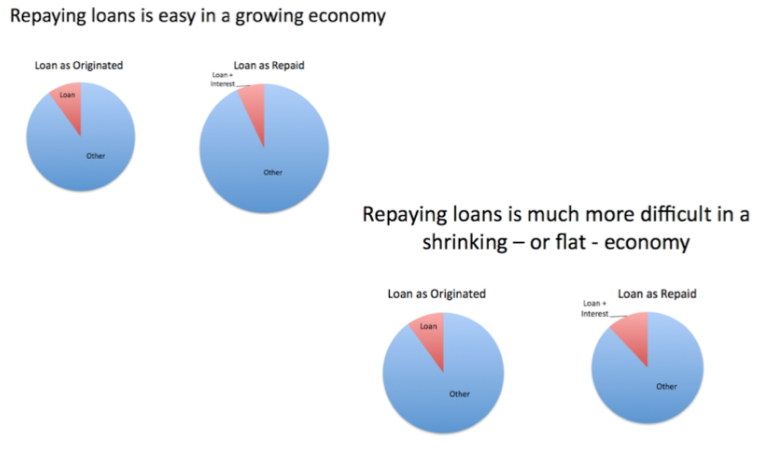
Figure 2. Repaying loans is easy in a growing economy, but much more difficult in a shrinking economy.
Another issue is debt repayment (Figure 2). We are used to an ever-expanding economy, where future goods and services produced will always be greater than those produced this year. As long as this growth pattern persists, our system of long-term financing of major expenditures, even if the expenditures are not really income producing, can continue. For example, we are able to buy homes with 20 or 30 year loans, and governments are able to continue borrowing, claiming that they will have more funds to repay loans (with interest) in the future. Once the situation changes to a shrinking economy, it becomes much more difficult to repay loans, and the financial system quickly reaches the risk of collapsing, due to multiple debt defaults.
A related issue is that of financing a new or expanding company. If the economy continues to grow, investment in a new company is likely to make sense because the value of the company can be expected to grow as the demand for products of the type it sells continues to grow. But if it becomes clear that the economy is on a path of long-term contraction, the possibility of failure within a few years rises, so new investment makes much less sense. . . .
Tuesday, November 22, 2011
Post-collapse Transit Options: Small is Beautiful
Labels:
Better Ways,
Cherriots,
Peak Oil,
Possible Futures,
Transition Salem
Wednesday, November 16, 2011
Monday, November 14, 2011
Thursday, November 10, 2011
Oh, by the way, . . . LOOK OUT!
Tom Whipple, Falls Church News Press, VA - With little fanfare, a press release appeared last week on the website of the UK Industry Taskforce on Peak Oil and Energy Security. The release said that during a meeting between Chris Huhne, the UK's Secretary of State for Energy and Climate Change, and representatives of ITPOES, an agreement had been reached that Her Majesty's Department for Energy and Climate will collaborate with ITPOES on a joint examination of concerns that global oil supply will begin to fall behind demand within as little as five years. This collaboration is seen by the British government as the first step in the development of a national peak oil contingency plan.
There are many implications buried in this seemingly innocuous announcement. First, American readers should note that the British government recognizes that energy policy and climate change are inextricably linked so that you cannot formulate policies for one without the other. The major step forward, however, is the official and semi-public recognition by a major government that global oil supplies will fall behind demand in as little as five years. After years of official denial this is indeed a breakthrough worthy of note.
Gone is the rhetoric about the billions of barrels of oil remaining that will last for so many decades that nobody alive today needs to worry. Official recognition has been given to the concept that the remaining oil will be so expensive to extract or will be locked into the earth by intractable political disputes, so that it simply will not be available in the unlimited quantities or at the prices we have known for the last 100 years. Also implicit in the announcement is that ever-rising real energy costs will destabilize nearly all of the world's economies and that economic growth in the form we have come to know it will no longer be possible. . .
Tuesday, November 8, 2011
Thursday, November 3, 2011
This is what peak oil looks like up close -public budget meltdown
Salem has a LOT of people who are going to be in similar, terrible straights as L_____ as the constant erosion of our unsustainable way of life proceeds. When you build a society that is 100% dependent on abundant cheap energy, don't be surprised when the effects of the end of cheap energy are bad.
Subject: Re: This is what peak oil looks like up close -public budget meltdownThx - this really is the face of peak oil, and our human reactions are mostly as expected (see any number of peak oil task force reports now gathering dust).
There's already significant pressure to cut school busing budgets in our area --- this will really clobber strung-out districts like the one we're in --- kids get to Mt. Baker Jr/Sr high from as much as 30 miles away. We are about 6 miles distant, ok for biking (in good weather). AFAIK, nobody in our district's school management system is even thinking about the implications of this. It Will Not Be Pretty when Those Who Vote find their kids stranded at home. [They always] pick off the most defenseless first, per this article, but in our situation that ain't where it ends.
Back when I was riding the transit bus one-way with my bike for commuting, people I talked with usually said they didn't like to ride the bus because of odd people on it, and viewed the transit system as rides for the disabled (meaning in effect those who could not get/keep a driver's license) --- and to a large degree that was and is very true out here in the county (less true in town because of colleges & greenies). And the first place the WTA wanted to cut when the time came? Easy to guess, eh? County routes (on the basis of 'low occupancy'). "Those people" don't vote . . .
Several programs L_____ depends on for her way of life are now under annual attack --- housing subsidy, job assistance, social security, medical. I'm nearly certain we'll be having to change the way she's living in town in the next few years. Would be nice to f---- over some bank in the process.
tooj
Tuesday, October 18, 2011
Saturday, October 1, 2011
Subscribe to:
Posts (Atom)