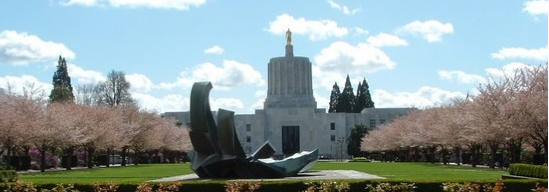
On Monday, Dec 8, at 5:30pm, there will be a brief "work session"before the Salem City Council meeting to unveil 4 designs for the proposed bridge from Riverfront Park to Minto- Brown Island. The work session is not structured for public comment, so it will just be an opportunity to look at the designs. Later the City will solicit comment. In any event, it's a great opportunity to see what could be the next piece in downtown park connections. It's also an opportunity to show City Council that bicyclists care. If you are interested, please consider attending.
http://www.cityofsalem.net/MeetingAgendas/default.aspx
Also, Friends of Two Bridges has established a tentative date for the Union Street RR Bridge opening ceremony. This is contingent on construction being complete, so it's far from definite. Nevertheless,
you should pencil in Saturday, February 21 for the inaugural ride across the river!
Friday, December 5, 2008
See Riverfront Park-Minto Brown bridge design ideas


Monday, December 1, 2008
Against Turning the Road Gang Loose
Infrastructure spending is an investment, and there are some jobs available building infrastructure. But the time when you're reeling drunk from the temporary price collapse of oil is not the time to make big, long-term capital investment decisions.
We need to make investment decisions as if oil was still $140 a barrel, because it will be there again soon enough. Then the money invested in infrastructure would truly be invested, because it would make us more capable of coping with that $140/bbl oil, and $200/bbl oil and so on.
Oil is down only because our economies can no longer function on "hallucinated" currency (h/t to James Kunstler for the perfect description of our credit binge). We'll be in a long recession or depression, and as long as daily pumping capacity even slightly exceeds world demand, prices will be low. But that's a big if, and an unpleasant one. In a world of 6.7 billion people and climbing, keeping oil demand below extraction capacity means that the per human usage has to keep going down just to stay still. And that means economic misery is baked in. As soon as "recovery" starts to gain steam, demand will increase. We're at such a tenuous balance around 87 million barrels per day (for all liquid fuels) that the instant demand exceeds supply, prices will leap up again.
President-elect Obama said something that made me feel a lot better about him right after his election: he said that falling oil prices made it even MORE vital that we deal with our energy addiction, because of our history of alternating between hysteria and coma when it comes to thinking about energy. That's an important insight, and for the guy in the White House to recognize that bodes well for us.
All the money that the road gang is lusting after would create just as many jobs if turned onto building a new electric grid and into electrifying heavy rail and building a close, fine-grain network of light rail systems that will enable America to get through its perpetual adolescence of auto addition once and for all. And then, when oil prices shoot up again, we'll be in the catbird seat, instead of on the torture rack.
UPDATE: Oregon Environmental Council adds this.
Tuesday, November 25, 2008
New resource book for the new reality: Toolbox for Sustainable City Living
About the book
The Toolbox for Sustainable City Living is a DIY guide for creating locally-based, ecologically sustainable communities in today's cities. Its straightforward text, vibrant illustrations and accessible diagrams explain how urbanites can have local access and control over life's essential resources: food production, water security, waste management, autonomous energy, and bioremediation of toxic soils. Written for people with limited financial means, the book emphasizes building these systems with cheap, salvaged and recycled materials when possible. This book will be an essential tool for transitioning into a sustainable future threatened by the converging trends of global warming and energy depletion.
Topics covered in the book include:
- Aquaculture: ponds, plants, fish and algae
- Microlivestock and city chickens
- Rainwater Harvesting
- Low-tech bioremediation: cleaning contaminated soils using plants, fungi and bacteria
- Constructed Wetlands/ Greywater
- Autonomous energy: bicycle windmills, passive solar
- Biofuels: veggie oil vehicles, methane digesters
- Struggles for land and gentrification
- Humanure and worm composting
- Floating Islands to clean stormwater
- Asphalt removal and air purification
- And much more!
About the Authors:
Scott Kellogg and Stacy Pettigrew are co-founders of the Rhizome Collective, a non-profit organization based in Austin, Texas. Over the past seven years, they have transformed a burnt-out warehouse into the Rhizome Collective: a thriving Center for Community Organizing and Educational Center for Urban Sustainability.
Stacy and Scott both have extensive experience in the fields of ecological design and community activism. Stacy is Rhizome's Program Coordinator and Scott is the Director of the Educational Center for Urban Sustainability. They have designed and built numerous sustainable systems for display as teaching models, including constructed wetlands, rainwater collectors, aquaculture ponds, windmills, passive solar devices, and bioremediation tools. They also created and host RUST, an intensive weekend seminar in urban ecological survival skills. Scott and Stacy have authored numerous articles on sustainability and the Rhizome Collective and frequently give presentations on radical sustainability at universities and political gatherings across the country. They have taught workshops in locations as diverse as the Bronx to East Timor. Scott has also been active in building a community based bioremediation program in post-Katrina New Orleans.
Support Salem Cinema
 At Salem Cinema we passionately believe that while the current economic news is bleak, escaping to the movies is still one of the most inexpensive forms of leisure and enjoyment available in this great country of ours. We know we are all in this crisis together and are happy to not only continue to provide a sanctuary of exceptionally high quality, thought-provoking entertainment at the same reasonable prices we charged well over a year ago, but to bring back our special annual holiday savings offer as well.
You can once again purchase $30 worth of our CineBucks
for only $25 during the entire month of December!
CineBucks come in $5 increments and work just like cash at our box office or concession stand. Pick some up for friends, co-workers, teachers and relatives...and even pocket a few for yourself!
Good advice for citizens: Establishing the performance-target ethic
How can citizens determine whether their government is performing well?
One way is to compare its current performance with past performance, but this has some obvious shortcomings.
Another way is to compare its current performance with that of similar agencies in similar jurisdiction. This approach, however, also comes with some flaws.
Another possible approach is to compare a jurisdiction's or agency's performance with the targets it has set for itself. For this to work, however, public officials will have to accept the responsibility for setting such targets.
Consequently, Bob has focused the November issue "On why citizens need to establish The Performance-Target Ethic." You can find it at:
Survey re: Cherriots Cuts (do before 12/8)
Please take this survey to help us decide what services are important to you!
The Public Hearing on proposed service reductions will be held at the Board of Directors meeting on December 11, 2008, at 6:30 PM, at 555 Court Street NE, Senator Hearing Room, Salem, Oregon.
This survey will help us make the best choice for you.
The last day to take the survey will be Monday, December 8, 2008
Opportunity to Help Shape Cherriots Cuts
These events will be held in the Senator Hearing Room:
· Dec 1, Monday from 5:00 PM - 7:00 PM
· Dec 2, Tuesday from 9:00 AM - 11:00 AM
· Dec 2, Tuesday from 5:00 PM - 7:00 PM
· Dec 5, Friday from 10:00 AM - 2:00 PM
Salem-Keizer Transit
Monday, November 24, 2008
Sunday, November 23, 2008
The Appalling Crisis
Here's a brief summary of an excellent book on population and our misconceptions about it (now out of print, available for free download in pdf at the link below):
Misplaced Blame
The Real Roots of Population Growth
Misplaced Blame argues that much of the population growth overrunning parts of North America originates from five rarely noted root causes: poverty, sexual abuse, underfunded family planning services, subsidies to domestic migration, and ill-guided immigration policy.

By Alan Thein Durning and Christopher D. Crowther
"In Misplaced Blame, the authors have assembled the statistical data from hundreds of sources and combined them into a story of how the growing Northwest is growing in all the wrong ways." - Ed Hunt, Tidepool
Note: Misplaced Blame is out of print, but you can download the pdf version for free with registration.
Misplaced Blame argues that much of the population growth overrunning parts of North America originates from five rarely noted root causes: poverty, sexual abuse, underfunded family planning services, subsidies to domestic migration, and ill-guided immigration policy. Along the way, Misplaced Blame uncovers one revelation after another. Some examples:
- The population of the Pacific Northwest is increasing almost 50 percent faster than global population.
- 83 percent of American teen mothers come from poor families.
- 62 percent of teen mothers have been raped or molested as children.
- 36 percent of babies born in the Northwest are conceived by accident.
- Long-distance moving is subsidized by taxpayers.
- Excessively high national immigration quotas hurt both the North American poor and immigrants' home countries.
Read Misplaced Blame and you'll see that when we take care of people, population growth will take care of itself.
Here are a few links to key fact sheets from Misplaced Blame.
- Misplaced Blame - Excerpt
- Ensure Every Child is Wanted: A key principle of sustainability.
- Make Emergency Contraception Widely Available: The Northwest can curb unintended pregnancies by ensuring easy access to emergency contraceptive pills such as Plan B.

 Posts
Posts


