
Sunday, September 14, 2014


An interesting contrast

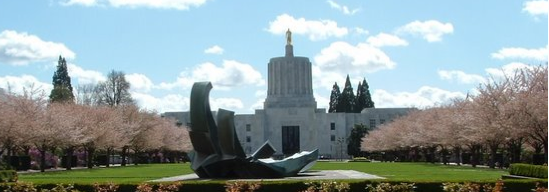
Compare the city officials' contempt for Salem history (the same contempt that brought us an ugly parking lot where the old city hall was) with the money being spent on a far less historically important structure at the train station.
http://www.oregon.gov/ODOT/COMM/Pages/SalemRRBaggageDepot.aspx
This is not criticizing the baggage depot project, which is worthy. This is only to point out that demolishing Howard Hall -- for even more parking -- is a reckless, thoughtless act of official vandalism. Doing so while saving and restoring that baggage depot only underscores the point.
In 2001, the Taliban destroyed the Buddhas of Bamiyan and the world recoiled. In Salem, the Sprawl Talibanis are equally zealous and happy to sacrifice our historical treasures for more sprawl furnishings.
Saturday, September 13, 2014
Another unsolicited plug
Salem has some amazing artists; here's one of them:


Caren Ann Jackson Photography
presents
New images from around the world
Canvas, photography trivets, and greeting cards
Now showing at Salem Convention Center
Upcoming events
Westminster Presbyterian Fine Art Show
October 10 & 11
Salem Public Library
Month of October
Art Show & Sale Open House Market
Saturday November 8, 1:00-5:00
596 Salem Heights Ave S
503-569-6506
Something great happening in Salem community resiliency & Saving Howard Hall
Some local pioneers are following their dreams to give Salem something wonderful, a skills-building program that at the same time addresses a real need for more quality, inexpensive bikes.
As the new normal continues its rollout, and as car-centric thinking and car-centered society is increasingly shown to be a dead-end leading only to wars and pollution, bikes are going to make a giant leap ahead. The trick will be helping the transition be smooth and comfortable, rather than one that makes people feel loss and impoverishment as the old gives way to the new.
We need places like NW Hub throughout Salem, in every neighborhood really.
Instead of squandering millions planning to waste many times more and on destroying Salem's past, a city that cared about the future would be figuring out how to put a combination community cycling center, library, food bank, extension service, tool bank, public health resource, and meeting hall in every neighborhood, in preparation for the much more local future we will inhabit.
The first one could be in Howard Hall.
Such centers are just another idea among the
Billion Better Ways to Budget a Billion Bucks for Salem
(Than a Giant Hunk of Sprawl Propellant called a "Third Bridge")
(Content below lifted from the invaluable "Salem Breakfast on Bikes" blog, a slightly dada name for one of the best Urban-focused blogs in Oregon.)
Northwest Hub
Hopefully the weather will hold, because later in the month there's a new ride in town!
 Northwest Hub is working on a project for Salem similar to Portland's Community Cycling Center. The Hub at Evergreen Church and the YMCA/Hillcrest Second Chance Recyclery are joining up and building out.
This is a fund-raiser for them as they seek to secure a storefront and workshop space.
The ride's on Saturday, September 27th at 8am. (The starting point of 400 Capitol St NE looks like the "Red Lot.")
You can register for the ride here. Day of ride registration will also be available starting at 7:30am.
(Look for more as the date approaches!)
----
(Content below lifted from the invaluable "Salem Breakfast on Bikes" blog, a slightly dada name for one of the best Urban-focused blogs in Oregon.)
Northwest Hub
Hopefully the weather will hold, because later in the month there's a new ride in town!
This is a fund-raiser for them as they seek to secure a storefront and workshop space.
The ride's on Saturday, September 27th at 8am. (The starting point of 400 Capitol St NE looks like the "Red Lot.")
You can register for the ride here. Day of ride registration will also be available starting at 7:30am.
(Look for more as the date approaches!)
----
"Let's live on the planet as if we intend to stay."
Why so many kids can’t sit still in school today [feedly]
School as pre-prison, start damaging them early, and keep it up throughout K-12.
In the name of helping them be "competitive" in the global economy.
We need to apply the same tests to school that we do to any other form of experimentation or drug treatment for children: show us the evidence (not the assumption) that what you do and how you do what you propose to do is in the child's best interests.
----
Why so many kids can't sit still in school today
http://read.feedly.com/html?url=http%3A%2F%2Fwww.washingtonpost.com%2Fblogs%2Fanswer-sheet%2Fwp%2F2014%2F07%2F08%2Fwhy-so-many-kids-cant-sit-still-in-school-today%2F%3Ftid%3Dtrending_strip_4&theme=white&size=medium
----
Shared via my feedly reader
----
Why so many kids can't sit still in school today
http://read.feedly.com/html?url=http%3A%2F%2Fwww.washingtonpost.com%2Fblogs%2Fanswer-sheet%2Fwp%2F2014%2F07%2F08%2Fwhy-so-many-kids-cant-sit-still-in-school-today%2F%3Ftid%3Dtrending_strip_4&theme=white&size=medium
----
Shared via my feedly reader
"Let's live on the planet as if we intend to stay."
Friday, September 12, 2014
Salem Cinema stuns again

Treat yourself. Go see Boyhood. You won't regret it -- or forget it.
And the Manhattan Shorts are coming! Just another reason to take deep satisfaction in having this amazing gem of a theatre right here in Hooterville.
A model for Salem . . .
A way to fund some of the projects identified in the
"Billion Better Ways to Budget a Billion Bucks"
(than on a sprawl promoting Boondoggle).
----
Crowdfunding Fans Are Crazy About Denver's Mini-Bonds
// Next City Daily

----
Shared via my feedly reader
----
Crowdfunding Fans Are Crazy About Denver's Mini-Bonds
// Next City Daily
(AP Photo/Ed Andrieski)
Denver gained notice in the municipal funding world last month when a $12 million public offering of "mini-bonds" sold out in a single hour. The sale was supposed to run for five days. The $500 mini-bonds were tied to the $550 million municipal bond program called Better Denver.
Related Stories
Demand was so high and the cap was reached so quickly that afterward, 375 online orders had to be refunded.
"Denver residents — and these bonds were also open to all Colorado residents — really appreciated the opportunity to invest their money in good projects in their own community that they see everyday when they drive around town," says Deputy Mayor Cary Kennedy, who is also the city's chief financial officer.
Two types of $500 bonds were sold: A nine-year bond will mature 50 percent to $750, and a 14-year bond will mature 100 percent to $1,000. The money has been earmarked for recreational and cultural facilities, like the restoration of the McNichols Building, a historic building in Civic Center Park that will be re-opened as an event center.
Better Denver passed as a ballot initiative in 2007. That year the city sold $8 million in mini-bonds over the course of a week. Kennedy attributes the feverish excitement this year to the online ordering system: "Back [then], we didn't have the online capacity. People had to visit the bank or mail in their orders. This time around people were sitting at home on their computers at 8 o'clock in the morning and those orders came in very quickly."
Pat Sabol, a senior policy and research assistant at the Brookings Institute's Metropolitan Policy Program, says that although Denver isn't the first city to offer mini-bonds, the practice is still pretty rare. The Mile-High City's recent success demonstrates that mini-bonds are ripe to be replicated elsewhere. "In the past, it was such a logistical nightmare," he explains, "just tracking down each of these people and keeping track of them, but I think now that there's more interest in people investing in their communities. There's more awareness around infrastructure issues.
"In Denver," he continues, "they've done a really good job of saying, 'Hey, this is what this is going to fund. You can trust us. These are great projects we can really make happen.' Places are a bit savvier about communicating their needs to their population."
Sabol goes on to say that mini-bonds are "not necessarily the most efficient way to make money." Traditional municipal bonds go for much higher (from $20,000 into the millions), and they are pretty low-risk investments for institutional investors. But there are advantages when a city offers mini-bonds to its residents, such as generating community enthusiasm about infrastructure improvements and also demonstrating to the market that there is demand.
"Right now, as an everyday person," he says, "it's pretty difficult to invest in my community besides me paying taxes or going out and doing a community garden. If I care about infrastructure, it's pretty hard for me to invest in it. If you give people a safe path to do that, which Denver has done, you can go on their website and see how well they've done … this is really savvy urban planning and really good outreach and communications."
Hyperlocal, crowdfunded investments are on the rise, with real estate opportunities like New York's CityShares and Washington, D.C.'s Fundrise appealing to the public's attachment to place. Sabol distinguishes mini-bond programs from these by noting that the money is going toward things like road improvements and community centers — things that are "absolutely public-focused assets."
Kennedy reiterates his point. "There's a trend, here in Denver, but also nationally of people wanting to invest back in their communities," she says. "That shows up in a lot of different forms, and this is one way for the people of Denver to invest locally, but I think it's something we are going to see more of in the future."
----
Shared via my feedly reader
"Let's live on the planet as if we intend to stay."
The headline alone says all you need to Know to Vote NO on 90
The Top-Two, so-called "open primary" should really be called the Privatized General Election, as the whole point is to allow wealthy donors to buy elections as cheaply as possible by eliminating all candidates but two back when a little money makes a huge difference (in the primary, before most voters pay any attention), but then make those two come crawling for corporate cash in a zero-sum face off, with all possibility of new ideas eliminated.
There can be no better design for making everything about our already-toxic politics even worse than "Top Two", a carefully focus-grouped name for what is normally called the jungle primary.
If we want an open election system, it's easy: eliminate primaries entirely, make parties responsible for nominating their own candidate or candidates and then have a general election where all voters can rank all the candidates in order of preference, 1, 2, 3 ... And so on. The Oregon Constitution already specifically allows for preference voting, a much faster, better and cheaper system.
----
Oregon 'Top two' primary initiative picks up additional business contributions | OregonLive.com
http://www.oregonlive.com/mapes/index.ssf/2014/09/oregon_top_two_primary_initiat.html
----
Shared via my feedly reader
----
Oregon 'Top two' primary initiative picks up additional business contributions | OregonLive.com
http://www.oregonlive.com/mapes/index.ssf/2014/09/oregon_top_two_primary_initiat.html
----
Shared via my feedly reader
"Let's live on the planet as if we intend to stay."
Thursday, September 11, 2014
MUST READ on our toxic politics: Slate piece on fair representation voting by Reihan Salam
"Let's live on the planet as if we intend to stay."
The Biggest Problem in American Politics
Forget gerrymandering. Here's what we need to fix to ensure truly fair elections.
By Reihan SalamPhoto by Eric Thayer/Reuters
As a conservative living in New York City, my vote for Congress is essentially a socially approved form of venting. A short while ago, I moved from an extremely liberal neighborhood in Manhattan to an extremely liberal neighborhood in Brooklyn. In my old apartment, I was represented by Jerrold Nadler, an extremely liberal Democrat. In 2012, he defeated his Republican opponent, the redoubtable Michael Chan, by a margin of 69.8 percent to 16.6 percent. In my new home, I am represented by Nydia Velázquez, also an extremely liberal Democrat. She trounced her Conservative Party opponent, James Murray, by 79 percent to 4.4 percent in 2012. More depressing still, Murray was crushed by blank ballots, which accounted for more than 16 percent of the total. Something tells me that Velázquez is not losing sleep over her re-election bid.
To be sure, had I moved to Staten Island or Bay Ridge in Brooklyn, I would have found myself in the congressional district of Michael Grimm, a colorful Republican who likes to mix it up with the press. But Grimm is considered one of the most endangeredincumbents in the House, thanks in no small part to, um, a 20-count federal indictment relating to, among other things, his alleged mismanagement of his old health food store, Healthalicious. (You know, the usual.) There is an excellent chance that in a few months' time, New York City's congressional delegation will consist entirely of Democrats.
None of this should come as a shock. New York City is a liberal town, and I've long since resigned myself to being part of a small political minority. What I find galling is that, as observed in May by Rob Richie, the executive director of the electoral reform group FairVote, there are actually quite a few conservatives in New York City—believe it or not, Mitt Romney won 435,000 votes here. If Grimm goes down in November, Republicans in New York City will have no representation at the national level, an outcome that Richie rightly sees as a reflection of a much larger problem.
I don't expect you to weep for the Big Apple's hearty band of unreconstructed Reaganites, as we are, after all, free to pick up stakes and move to Wyoming. Yet the problem we face—that our political influence doesn't match our numbers—is one faced by many groups, including liberals in conservative parts of the country, and members of racial, ethnic, and other minorities who want and consistently fail to get their fair share of political power. The root of the problem, as Richie and the good people at FairVote have long maintained, lies in our reliance on single-member districts to elect legislators.
What's wrong with single-member districts? Let's start with gerrymandering, the practice in which the officials charged with drawing the boundaries of our various legislative districts do so with an eye toward boosting the members of a particular political party or group. There are many people who believe that gerrymandering is the root of all evil in American political life, and that we need to draw districts in an entirely apolitical manner. That is a fantasy. As long as we have single-member districts, it is inevitable that some group of people will be disadvantaged by the lines we draw, whether or not the line-drawers have sinister motives.
Take the problem of Democratic underrepresentation in the House. If we assume that the parties should win congressional seats roughly in proportion to their share of the vote, Democrats in 2012 were underrepresented by a whopping 18 seats, according toan analysis by Christopher Ingraham. In Pennsylvania, for example, Democratic candidates won just more than 50 percent of the vote in the 2012 congressional elections while winning just five of the state's 18 congressional districts.
Nate Cohn of the New York Times' Upshot has written that while partisan gerrymandering has indeed given Republicans an edge in holding the House of Representatives, the deeper problem is that Democrats are highly concentrated in densely populated urban and suburban districts, like those in and around Philadelphia and Pittsburgh in Pennsylvania. By contrast, Republicans are, as a general rule, more evenly distributed across the map, which allows them to win more rural Pennsylvania districts with smaller margins. Slate's David Weigel has replied, reasonably enough, that there is an easy workaround to the fact that Democrats like to live cheek-by-jowl: simply carve up the cities in which they live and parcel them out across different congressional districts that also include less densely populated Republican territory. But this approach seems like just another way to institutionalize unfairness. If we wind up with pizza-slice districts that distribute Democrats into a larger number of heterogeneous districts, Republicans will complain that their voices have been squelched.
If our goal is to create legislative districts that truly reflect their electorates, our best bet would be to give up on single-member districts altogether and replace them with multi-member ones. Take the case of my tribe, the forlorn conservatives of New York City. Even if the New York state Legislature decided that it wanted to carve out a new district to represent conservatives scattered across the five boroughs, and not just those in Michael Grimm's swing district, they'd have an almost impossible time doing so. For one thing, we don't all live in a heavily Republican enclave called "Giulianiville." A similar problem arises for minority groups that aren't isolated in particular neighborhoods. The only reason it is possible to draw majority-minority districts for blacks in the Deep South and some Northern and Western cities is that black segregation is still with us. Drawing majority-minority districts for less-segregated minorities, like Asians, is a different story. (The only Asian-majority congressional district in the United States is in Hawaii, though there is one district in California's Silicon Valley that comes close.)
When you combine single-member districts into bigger multi-member districts, the picture starts to look quite different. The beauty of multi-member districts is that they allow us to use what FairVote calls "fair representation voting." (FairVote is stacking the deck a bit with that terminology, admittedly.) There are several different forms of fair representation voting, but FairVote is a fan of "ranked choice voting," a method that has been used in Ireland and, closer to home, Cambridge, Massachusetts, for decades. Under that system, voters rank-order several different candidates rather than choosing their single favorite. Here's an excellent video from Minnesota Public Radio explaining how it works:
As FairVote explains, the goal of this approach is to ensure that all candidates who receive a certain share of the vote will be elected. Some countries have huge multi-member districts that elect dozens of legislators. Israel elects all 120 members of the Knesset in a single multi-member district that encompasses the entire country. This guarantees that even very small groups can elect a representative who reflects their interests, yet it also severs the connection between a legislator and a given region. In the United States, FairVote envisions multi-member districts that would send no more than five representatives to Congress—big enough to represent relatively small minorities, but not so big that they don't have a connection to concrete communities.
In a district with three representatives, you'd need to win 25 percent of the vote plus 1 to get elected. In a district with five reps, you'd need to win 16.7 percent plus 1. Getting there is a bit complicated—it involves fractions. But the basic idea is that if there were a three-seat multi-member district in Texas in which 68 percent of the vote went to Republican candidates and 32 percent went to Democratic candidates, one of the scenarios FairVote offers in "Monopoly Politics 2014 and the Fair Voting Solution," it would send two Republicans and one Democrat to Congress. Of course, fair representation voting won't do much good in states that send only one member to Congress. The good it would do everywhere else, however, is reason enough to justify the idea.
It should be obvious why multi-member districts would appeal to Democrats, who really are disadvantaged by the status quo. But it should appeal to Republicans, too. Yes, it would deny the GOP an edge over Democrats in the short term. But at the same time, it would help stranded conservatives like myself, and it would guarantee that some political reversal of fortune wouldn't one day result in Republican underrepresentation.
There is an even better reason to favor fair representation voting: It might fuel the rise of new political parties. Getting to 50 percent can be challenging for Greens or Libertarians or other minor-party candidates who are asking voters to make a leap of faith. Getting to 17 percent in a multi-member district is far more realistic
Imagine if Netroots Democrats or Tea Party Republicans made an impact not by launching primary challenges but by setting up shop as separate political entities. Instead of dragging the major parties to the left or to the right, they'd be able to compete with them on a level playing field. It'd be a bit like the startup world, where venture-backed entrepreneurs routinely take on entrenched incumbents. Don't think your local Democrats are liberal enough? Vote Netroots! Tired of GOP squishes? Back the Tea Party!
Not everyone likes the idea of a multi-party system, I realize. There is a neat symmetry to two-party politics, and it is true that our big, lumbering parties are capable of change, albeit at a slow pace. Yet it's hard to deny that a two-party system is best understood as a zero-sum game, in which a victory for one party is seen as a defeat for the other. This makes meaningful cross-party cooperation vanishingly rare. A multi-party system, in contrast, is one in which your enemy on one issue might become your ally on another. Netrooters might fight Tea Partiers tooth and nail on the top marginal tax rate one day while working alongside them to curb crony capitalism the next. They might join with Democrats on one issue and Libertarians on the next. This ever-present need for coalition-building creates a powerful incentive to treat your political rivals with respect, even when you disagree with them. That would make for a much healthier political culture—and certainly a more interesting one.
Reihan Salam is a columnist for Slate.
 __,_._,___
Subscribe to:
Posts (Atom)

 Posts


