Friday, September 11, 2009

This is it: Council to decide urban hens this coming Monday, Sept. 14

Chicken CoopHome of the terrifying urban hen. Image by dj denim via Flickr

Well, this is it, at least for now. The unelected Planning Commission members voted against recommending that Salem revise the zoning ordinance to exempt hens kept as pets from the definition of livestock, but the Council is free to ignore that advice and to do the right thing by exempting hens from the zoning code and drafting a hens ordinance under the regular city health code.

There appear to be five votes on the Council in favor of allowing most people in single-family homes to keep a few hens, but they definitely need your encouragement and support this coming Monday night.

Please plan to attend and to speak up first thing (since the item, 4.3a, is not a public hearing, your opportunity for comment is at the beginning of the meeting [pdf warning] -- that will be at roughly 6:30, so plan to be there and sign up for comment by 6:15 in City Hall council chambers).
Reblog this post [with Zemanta]

Scalding dose of reality noticed

A "McMansion" under construction wit...McMansion complete with "lawyer foyer" and all the other trappings of wealth suitable for an end-stage empire. Sadly, a species of "home" not entirely unknown in Salem. Image via Wikipedia

This "Nature Bats Last" blog is something else. A choice excerpt from his latest:

We're driving slowly and stopping often, primarily because the Obama administration's Keynesian approach to saving the industrial economy necessitates throwing money at the highway departments of every state in the country. The attendant "shovel-ready projects" are clear examples of the lengths to which industrial humans will go to sustain the unsustainable, maintain the immaterial, and generally restore the irredeemable for a few more months.

The many miles and frequent pauses reveal to any sentient animal the sheer lunacy of the living arrangements we've built for ourselves. Within the span of a couple generations, we abandoned a durable, finely textured, life-affirming set of living arrangements characterized by self-sufficient family farms intermixed with small towns that provided commerce, services, and culture. Worse yet, we traded that model for a coarse-scaled arrangement wholly dependent on ready access to cheap fossil fuels. Then we ratcheted up the madness to rely on businesses that use, almost exclusively, a warehouse-on-wheels approach to just-in-time delivery of unnecessary devices designed for rapid obsolescence and disposal.

Simply ingenious, wouldn't you say?

The entire region, formerly abundant with a multitude of edible crops, currently is brimming with a single commodity: #2 corn. It's Roundup-ready, at that, just to throw a bucket of insulting acid into the face of reason. Roundup-resistant weeds are popping up throughout the region as we bring Farmageddon to the heartland and eventually to the world. Most of the corn, which is essentially inedible until it is processed (i.e., pummeled with inordinate quantities of fossil fuels), is watered with the last remaining drops of the Ogallala aquifer, brought to the surface with the same finite fluid used to power our trucks and cars. Verdant fields of ethanol dreams are interrupted occasionally by a field of soybeans; without rotations of legumes, the soil would be so depleted of nitrogen by king corn, it wouldn't support even the great corn desert. The corn fills our bellies with death-inducing faux sugar. But we willingly trade some of that "food" for fuel because the associated dependence on automobiles allows us to burn off the final inches of life-giving topsoil to promote our culture of death in rapid-transit, individualized death-traps. Who could pass up a deal like that?

Obnoxiously ubiquitous cell-phone towers line the edges of the cornfields adjacent to the Eisenhower Interstate Highway System ("Celebrating 50 Years, 1956-2006"). Each of these completely unnecessary towers of mortality -- which serve only to duplicate extant infrastructure -- kills 5,000 to 15,000 birds each year. Yet every imperialist has a cell phone, regardless of the death to songbirds. Don't even get me started on the col-tan in the cell-phone batteries mined from the Congo, because I'd rather not think about the brutal lives and tortuous deaths of the Congolese women and children we treat as collateral damage along our imperial path.

Seemingly every tenth cell phone marks a casino, yet another ubiquitous structure we'd be far better off without. These businesses extract money from the poor as they pursue the something-for-nothing goal upon which our culture has become based during the last few decades.

If it's not a casino, it's a distribution center for this country's rapidly waning commercial sector. We no longer make much of anything in this country, but we move around ton after ton of cheap plastic crap to the Targets and Wal-Marts that have displaced family owned businesses in every town and city in the country while exporting disaster capitalism throughout the world.

Finally, then, we come to the most ludicrous part of the entire endeavor: suburbia, filled with McMansions. This not-quite-country, not-quite-city living arrangement requires people to buy one of everything for every house -- except cars, of which we need at least two -- to live far from work, far from play, and far from the things we "need" to buy. Hundreds of acres of shoddily constructed, castle-like symbols of self-indulgence are separated from equally coarse-scaled places we use to grow "food," conduct "commerce" in our "service" economy, and otherwise live civilized lives. As has often been the case, today's symbols of gluttony are tomorrow's death traps.

As usual, I'm quick to point out the silver lining in this otherwise disastrous narrative: Better days lie ahead. How could they not?

In the near future, we'll return to a durable set of living arrangements. Since we need about 50 million additional gardeners to support the 300 million people in this nation, and because nearly everybody in the industrialized world would rather push electrons in a cube farm than push a shovel in a garden, I don't foresee us voluntarily returning to the agrarian age. Not only are a majority of people unaware of the predicament we face -- thanks to the media, every level of government, and our own self-absorbed preference for the bliss of ignorance -- but there's simply no leadership in the industrialized world as we face an inevitable but unprecedented economic contraction. As a result, I suspect we'll bypass agricultural pursuits and plunge right back to the post-industrial stone age. Once again, daily life will be characterized by a finely textured, life-affirming, durable set of arrangements characterized by respect for each other and reverence for the land, and accompanied by a solid dose of self-sufficiency.

Reblog this post [with Zemanta]

Monday, September 7, 2009

Happy Labor Day

{{en}}Unionization in the world {{fr}}La syndi...Image via Wikipedia

Read.

Gather all these mournful numbers -- the millions of Americans unable to find work, the 70 percent of workers under 35 who are unable to set aside any money, the nearly two out of three Americans approaching retirement age who fear they won't be able to retire, and the sub-nation of low-wage Americans routinely cheated on the job -- and what emerges is a picture of a country in decline. The first nation in human history to create a middle-class majority looks increasingly to be losing it. The economic security that was common, though by no means universal, in this country when the institutions created by the New Deal were strong, often provided by unionized corporations that felt compelled to offer insurance and pensions to their workers, is as dead as the dodo.

The Reaganite ideology of the past 30 years insisted that if Americans were freed from the constraints of government and unions and made responsible for their own economic security, a golden age would come. Sure enough, American businesses have eluded regulation and cast off their unions -- but they've left their workers in the lurch. If we fail to enact universal health care and laws that truly make it possible for workers to form unions again, each of our Labor Days will be grimmer than the last.


Reblog this post [with Zemanta]

Sweet and on-target: Surprise Hit on YouTube

Sunday, September 6, 2009

"The Best Health Care System in the World"


(For the rich. n/a for all others.) A very telling chart of comparisons:
From “Health bills might not protect needy Americans,” McClatchy, Sept. 4, 2009


Update: Bill Moyers: Mr. President, We Need a Fighter to Take on the Deranged Right-Wing

This health care thing is make or break for your leadership, but for us, it's life and death. No more Mr. Nice Guy, Mr. President.

Friday, September 4, 2009

Where's the Salem version?

Salem City Hall from across the pondHow sadly fitting that the most prominent front features of our city hall are parking garages that obscure the parts where the people are. Image by Jason McHuff via Flickr

The Sustainability Commission works to create a healthy community now and in the future by proposing measurable solutions to pressing environmental, social and economic concerns to the City of Eugene, its partners and its people.

Eugene Sustainability Commission

The Sustainability Commission was created in March 2007, following a recommendation from the Mayor's Sustainable Business Initiative taskforce. The commission focus is on all three aspects of sustainability - social equity, environmental health and economic prosperity.

The first meeting of the commission was held in late November 2007. The commission meets on the third Wednesday of each month, usually in the Bascom/Tykeson rooms of the downtown Public Library, 100 West 10th Street. Meetings generally start at 5:30 pm and end at 8:30 pm. Sustainability Commission meetings are always open to the public and include public comment time where you may offer comment or suggestions to the commission.

The commission acts as a policy advisory body to the council and city manager in the initiation or development of programs that will create or enhance sustainable practices within the community. The commission will advise on policy matters related to:

  • Sustainable practices;
  • Businesses that produce sustainable products and services;
  • City building design and infrastructure; and
  • Related issues that directly affect sustainability efforts considered by the city council

As outlined in the Ordinance that established the commission the commission shall:

  1. Make recommendations to the council and city manager for the programs or actions designed to implement the recommendations contained in the Sustainable Business Initiative Task Force report as accepted by the city council on October 23, 2006;
  2. Create and present an annual work plan to the city council;
  3. Meet annually with the city council to secure approval of the work plan;
  4. Provide a forum for addressing public concerns related to sustainable practices;
  5. Work on sustainability related policies as directed by the council and city manager;
  6. Provide input on sustainability policies and practices that reflect community values; and
  7. Assist the city council and city manager in balancing community priorities and resources by advising them on sustainability issues.

The first appointees to the commission will serve various terms of 2, 3 or 4 years. After this first term all members will serve a four year term, with the exception of the councilor who shall serve during the term of office. All members are limited to serving two consecutive terms.

Community Requests

The Sustainability Commission receives many different requests for endorsement, sponsorship or participation in projects. In order to be able to fairly evaluate these requests the commission asks that you provide a brief summary of your request, answering the questions in the community request form in no more than two pages. The commission needs the completed forms two weeks prior to commission meetings so they can review the requests. Requests received at commission meetings will be considered at the following meeting, to allow time for review.

For more information about the commission and past meeting agendas and minutes visit the City of Eugene website www.eugene-or.gov/sustainabilitycommission

Reblog this post [with Zemanta]

Thursday, September 3, 2009

Salem police officer shoots, kills pit bull running amok

Reading this story we can be thankful that Salem has its priorities straight and freely allows dogs that terrify and sometimes maim or even kill people while protecting us from the terror of urban hens!
Police responded to a report of the dog running loose and charging passers-by near Liberty Elementary School at 7 p.m., Salem Police Lt. Keith Blair said.

Officer Jacob Pratt found the pit bull at its owner's home in the 4900 block of Liberty Road S and called for backup and an animal-control stick to contain the dog, Blair said. While he waited, the dog charged Pratt, who fatally shot it, Blair said.

Investigation led police to determine that the dog had lunged at several people and that one woman had to dodge out of the dog's way to avoid being bitten, Blair said.

Wednesday, September 2, 2009

The Awful Truth: People who complain about traffic ARE the traffic

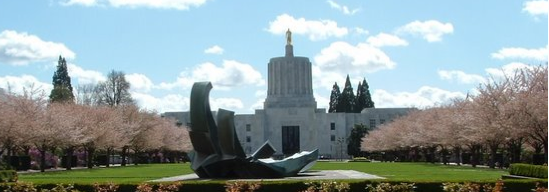
Capitol Building in Salem, OregonEver notice how postcard pictures never feature the one thing that our city gives more thought and money to than anything else . . .? (Making people defer to cars.) If it's such a good idea, why do we not like it? Image by adam79 via Flickr

Another great summary of the futility of trying to make cities for cars instead of people:

"The traffic you have is a matter of how much asphalt you have," said Gehl, who in his four-decade career has studied and supported the transformation of Copenhagen into one of the most bike-friendly sustainable cities in the world.

The temporary bike racks outside Persephone Theatre were nearly full Monday and Tuesday nights as people from across Western Canada gathered to hear the world-renowned architect deliver two sold-out presentations.

Making car drivers "happy when they are driving and happy when they stop" has been the No. 1 priority in planning cities for years, Gehl said. The "car invasion" will get worse every year until something is done.

"If you invite more driving, you have more driving," he said.

Reblog this post [with Zemanta]

Why is it called "The Land of the Free" again? (click to expand view)

Bank error NOT in your favor: Oregon banks to shun

McDonalds MONOPOLY Tournament in Vancouver (11)The reality behind the friendly face is that the banks listed are grabbing bailouts with both hands themselves while working to undermine Oregon and Oregonians. Image by Tostie14 via Flickr

Recently, your editor opened a checking account at Umpqua Bank. I had been leaning towards going with an account at Unitus Community Credit Union, but the darn Umpqua Bank pr machine was just too good and the downtown Salem location was perfect for me: near the library and the Post Office, and a chance to support a downtown Salem business, which is pretty high up on my priority list. Unitus is in some horrible bike-hostile location on Market Street near I-5 (hey, Unitus, lots of empty spaces in downtown Salem that would work for you!)

Then I found this story about the Babbits running the Oregon Bankers Association and their determination to make Oregon a rival for Mississippi in every category rather than just in higher education funding. So I called Umpqua and, lo and behold, Umpqua is a member of the OBA, which is why I'm going down there to close my account today and go to Unitus, which I should have done in the first place.

And I found a handy list of OBA members that I thought I would share, a handy guide to banks where you should never open an account, personal or business, or take a loan.

If you have a child, or want to be educated, or you care about an elder who might someday need long term care, or you have a house that needs fire protection, or if you value things like clean water and consumer protection, or if you are just plain smart enough to realize that states without abundant natural resource endowments (oil, etc.) cannot survive on a low-tax/low-services model without resembling the other backwards states using that model, you should carefully consider the many advantages of credit unions over these OBA banks, who are funding the fight to turn Oregon into a state that looks like a third world country, with a thin slice of rich people and a great mass of poor people and a hollowed out middle class. Credit unions provide small business accounts these days too, so you can move all your accounts from any of these OBA banks to a credit union and do yourself and all of us a world of good.

Albina Community Bank Allen Trust Co. Bank of America
Bank of Astoria Bank of Eastern Oregon
Bank of the Cascades Bank of the West Banner Bank
Capital Pacific Bank CenterPointe Community Bank
Century Bank Citizens Bank Clackamas County Bank
Clatsop Community Bank Columbia Community Bank
Columbia River Bank Columbia State Bank
Community Bank Cowlitz Bancorp, dba Bay Bank
Evergreen Federal Bank First Federal Frontier Bank
High Desert Bank Home Federal Bank Home Valley Bank
HomeStreet Bank KeyBank Lewis & Clark Bank
LibertyBank MBank Northwest Bank
Oregon Coast Bank Oregon Pacific Bank
Pacific Continental Bank Pacific West Bank
People's Bank of Commerce Pioneer Trust Bank
PremierWest Bank Riverview Community Bank
Siuslaw Bank South Valley Bank & Trust
Sterling Savings Bank Summit Bank The Bank of Oswego
The Commerce Bank of Oregon U.S. Bank
Umpqua Bank
Union Bank of California Union Bond & Trust Company
United States Trust Company Washington Trust Bank
Wells Fargo West Coast Bank West Coast Trust Co.
Willamette Community Bank Willamette Valley Bank
Reblog this post [with Zemanta]