How Being a Doctor Became the Most Miserable Profession
Nine of 10 doctors discourage others from joining the profession, and 300 physicians commit suicide every year. When did it get this bad?
By the end of this year, it's estimated that 300 physicians will commit suicide. While depression amongst physicians is not new—a few years back, it was named the second-most suicidal occupation—the level of sheer unhappiness amongst physicians is on the rise.
Simply put, being a doctor has become a miserable and humiliating undertaking. Indeed, many doctors feel that America has declared war on physicians—and both physicians and patients are the losers.. . . (More at the source)
Monday, April 21, 2014
When the internet dies, meet the meshnet that survives - 19 April 2014 - New Scientist
http://www.newscientist.com/article/mg22229653.700-when-the-internet-dies-meet-the-meshnet-that-survives.html?cmpid=RSS%7CNSNS%7C2012-GLOBAL%7Conline-news#.U1Uvxye9KSO
Saturday, April 19, 2014
Note to Salem City Council: How Cities Deal with Dissent Maturely
http://www.planetizen.com/node/68386
"A coalition group has collected enough signatures to suspend a newly-passed ordinance regulating companies like UberX and Lyft, and now Mayor Ed Murray wants to work with all stakeholders to reach a new agreement," reports Taylor Soper. The decision effectively puts the operation of transportation network companies back to square one, as if March legislation passed by the City Council in March to cap the number of drivers allowed to operate in the city at any given time never happened.
Seattle Mayor Muray has announced that the city and the companies will enter a 45-day negotiation process. Reports Soper: "If a compromise is reached during the negotiation process, the City Council could repeal the ordinance and then work together on a new set of regulations. If that happens, the referendum [as required by the signatures] would not appear on a ballot later this year."
Princeton study concludes U.S. government is an oligarchy – ‘The preferences of the average American appear to have only a minuscule, near-zero, statistically non-significant impact upon public policy’
----
Princeton study concludes U.S. government is an oligarchy – 'The preferences of the average American appear to have only a minuscule, near-zero, statistically non-significant impact upon public policy'
// Desdemona's Blog
By Tom McKayPrinceton Concludes What Kind of Government America Really Has, and It's Not a Democracy
16 April 2014
(PolicyMic) – A new scientific study from Princeton researchers Martin Gilens and Benjamin I. Page has finally put some science behind the recently popular argument that the United States isn't a democracy any more. And they've found that in fact, America is basically an oligarchy.
An oligarchy is a system where power is effectively wielded by a small number of individuals defined by their status called oligarchs. Members of the oligarchy are the rich, the well connected and the politically powerful, as well as particularly well placed individuals in institutions like banking and finance or the military.
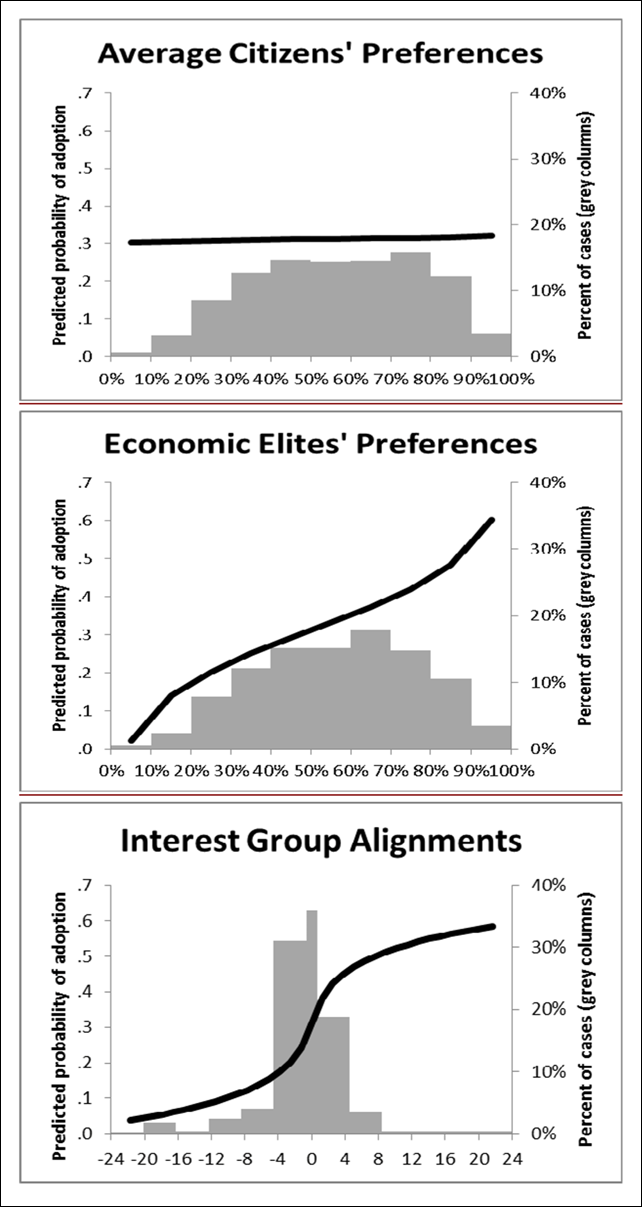
For their study, Gilens and Page compiled data from roughly 1,800 different policy initiatives in the years between 1981 and 2002. They then compared those policy changes with the expressed opinion of the United State public. Comparing the preferences of the average American at the 50th percentile of income to what those Americans at the 90th percentile preferred, as well as the opinions of major lobbying or business groups, the researchers found out that the government followed the directives set forth by the latter two much more often.
It's beyond alarming. As Gilens and Page write, "the preferences of the average American appear to have only a minuscule, near-zero, statistically non-significant impact upon public policy." In other words, their statistics say your opinion literally does not matter.
That might explain why mandatory background checks on gun sales supported by 83% to 91% of Americans aren't in place, or why Congress has taken no action on greenhouse gas emissions even when such legislation is supported by the vast majority of citizens.
This problem has been steadily escalating for four decades. While there are some limitations to their data set, economists Thomas Piketty and Emmanuel Saez constructed income statistics based on IRS data that go back to 1913. They found that the gap between the ultra-wealthy and the rest of us is much bigger than you would think, as mapped by these graphs from the Center On Budget and Policy Priorities.
Piketty and Saez also calculated that as of September 2013 the top 1% of earners had captured 95% of all income gains since the Great Recession ended. The other 99% saw a net 12% drop to their income. So not only is oligarchy making the rich richer, it's driving policy that's made everyone else poorer. [more]
----
Friday, April 18, 2014
How Being a Doctor Became the Most Miserable Profession - The Daily Beast
Thursday, April 17, 2014
Neil DeGrasse Tyson Said What He Thinks About Race Now That He's Made It, And Almost Nobody Noticed
To set the scene, the (poorly posed) question is referring to comments made by former Treasury Security and Harvard University President Lawrence Summers, who suggested that genetic differences could explain why there are fewer girls in science. Yup, he really was Treasury secretary and president of Harvard.
Neil deGrasse Tyson's answer is, um, out of this world. There, I said it. Let me have this one.
Wednesday, April 16, 2014
Vital reading on the supposed "oil boom"
http://www.csmonitor.com/Environment/Energy-Voices/2014/0416/Has-crude-oil-production-already-peaked
Monday, April 14, 2014
Plan now for May 1, 7 p.m. At Grand Theatre: The Healthcare Movie
Drive for Universal Health Care (DUH)
Health care activists from the east have been conducting a bus tour/caravan through the US and are now in California, headed for Oregon. They are expected to arrive in Grants Pass, accompanied by Laurie Simons and Terry Sterrenberg, producers of The Healthcare Movie, and singer-songwriter Bob Wickline, on Sunday, April 27. The schedule:These events will include a screening of The Healthcare Movie, with live performances by Bob Wickline, and panel discussions afterwards with filmmakers Simons and Sterrenberg, DUH activists Sue Saltmarsh and Donna Ellington, and local advocates. In addition, supporters are invited to drive with the caravan from city to city. Each car will be responsible for their own expenses and will decide how far they want to go. Identifying ribbons and bumper stickers will be supplied to all drivers!
- April 27, 2:00-5:00 p.m., Unitarian Universalist Church, 525 NE 6th St., Grant's Pass
- April 28, 6:30 p.m. Bijou Art Cinema, 492 13th Ave., Eugene
- April 30, 7:00 p.m., First Unitarian Universalist Church, Elliot Chapel, 1011 SW 12th Ave., Portland
- May 1, 7:00 p.m., Grand Theatre, 191 High St. NE, Salem
Find updates and details of the tour here.
Sunday, April 13, 2014
Energy and the Financial System: What Everyone Needs to Know… and Work Darn Hard to Avoid
Peak oil theorists have long been regarded by mainstream economists as the boys and girls who cried wolf. But just because the outlooks of mainstream economists failed to see the wolf does not mean it was not there. Rather, according to Roger Boyd's Energy and the Financial System: What Every Economist, Financial Analyst, and Investor Needs to Know, a rather large pack of wolves have been with us for quite some time now and our failure to deal with them has meant that they have grown in strength such that jointly they could derail the global economy.
To call Boyd a peak oil theorist, however, would be to reduce the complexity of his view for according to Boyd it is not only the availability of cheap oil that is in decline but rather what is in decline is the general availability of energy sources which provide a high amount of energy in return for energy invested. Indeed, Boyd's view revolves around a measure economists refer to as EROI, which measures the ratio between the amount of energy returned relative to energy invested. Thus we might better label Boyd a peak EROI Theorist for he believes that increasingly we will need to invest more energy in order to get energy back, as we have used up the vast majority of easily accessible high energy sources of oil, natural gas and to a lesser extent coal.
The importance of EROI is that to a large extent it determines the prosperity of society. The higher the EROI, the higher the prosperity levels, as we are able to direct more energy back into society rather than into producing more energy. According to Boyd, "our modern societies have become so hooked on nearly-free energy… with an EROI of at least 8 : 1 being required to maintain the high living standards and complex society to which we have become accustomed". Higher up the sophistication level Boyd cites that a societal EROI of up to 14:1 is required to support such things as good education, health care, and the arts. As the EROI continues to drop, however, it is not only the arts that we have to worry about, rather as Boyd's book illustrates the implications are potentially far reaching and devastating with the potential to reverse global prosperity and to do so rather unequally. . . .