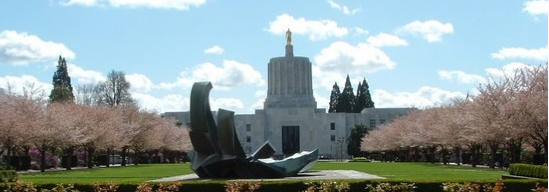
 There's no reason that agriculture and enjoyment of the park should be viewed as conflicting. Image by Mr.Thomas via Flickr
Nick Kristof, a native Oregonian, has an outstanding column today about "nature deficit disorder" -- the increasing tyranny of electronic doodads that dominate kids' lives and the paucity of contact with the natural world.
While backpacking here with my 11-year-old daughter, I kept thinking of something tragic: so few kids these days know what happens when you lick a big yellow banana slug.
My daughter and I were recuperating in a (banana slug-infested) wilderness from a surfeit of civilization. On our second day on the Pacific Crest Trail, we were exhausted after nearly 20 miles of hiking, our feet ached, and ravenous mosquitoes were persecuting us. Dusk was falling, but no formal campsite was within miles.
So we set out a groundsheet and our sleeping bags on the soft grass of a ridge, so that the winds would blow the mosquitoes away. Our dog looked aghast (“Ugh, where’s my bed?!”), but sulkily curled up beside us. As far as we could tell, there was no other hiker within a half-day’s journey in any direction.
We debated whether to put up our light tarp to protect us from rain. “No need,” I advised my daughter patronizingly. “There’s zero chance it’ll rain. And it’ll be more fun to be able to look up at shooting stars.”
It was, until we awoke at 4 a.m. to a freezing drizzle.
The rain not only punctured the doctrine of Paternal Infallibility but also offered one of nature’s dazzlingly important lessons in perspective, reminding us that we’re just tenants — and ones without much sway.
Such time in the wilderness is part of our family’s summer ritual, a time to hit the “reset” switch and escape deadlines and BlackBerrys. We spend the time fretting instead about blisters, river crossings and rain, and the experiences offer us lessons on inner peace and life’s meaning — cheap and effective therapy, without the couch.
All this comes to mind because for most of us in the industrialized world, nature is a rarer and rarer part of our lives. Children for 1,000 generations grew up exploring fields, itching with poison oak and discovering the hard way what a wasp nest looks like. That’s no longer true.
Paul, a fourth grader in San Diego, put it this way: “I like to play indoors better, ’cause that’s where all the electrical outlets are.” Paul was quoted in a thoughtful book by Richard Louv, “Last Child in the Woods,” that argued that baby boomers “may constitute the last generation of Americans to share an intimate, familial attachment to the land and water.”
Only 2 percent of American households now live on farms, compared with 40 percent in 1900. Suburban childhood that once meant catching snakes in fields now means sanitized video play dates scheduled a week in advance. One study of three generations of 9-year-olds found that by 1990 the radius from the house in which they were allowed to roam freely was only one-ninth as great as it had been in 1970.
A British study found that children could more easily identify Japanese cartoon characters like Pikachu, Metapod and Wigglytuff than they could native animals and plants, like otter, oak and beetle.
Mr. Louv calls this “nature deficit disorder,” and he links it to increases in depression, obesity and attention deficit disorder. I don’t know about all that, although his book does cite a study indicating that watching fish lowers blood pressure significantly. (That’s how to cut health costs: hand out goldfish instead of heart medicine!)
One problem may be that the American environmental movement has focused so much on preserving nature that it has neglected to do enough to preserve a constituency for nature. It’s important not only to save forests, but also to promote camping, hiking, bouldering and white-water rafting so that people care about saving those forests.
One sign of trouble: the number of visits to America’s national parks has been slipping for more than a decade. Likewise, Europe and Canada have both done an excellent job of building networks of long-distance hiking trails, while the U.S. has trouble maintaining the trails it has.
One of our family’s annual backpacks is the 40-mile Timberline Trail circuit around Mount Hood, crossing snowfields and dazzling alpine fields of flowers. In years when we’re particularly addled, we hike it as many as three times. But a washout almost three years ago left part of this gorgeous trail — completed in the 1930s — officially closed, and unofficially rather difficult to get by. Here’s a spectacular trail that was built in the last depression, and we can’t even sustain it.
So let’s protect nature, yes, but let’s also maintain trails, restore the Forest Service and support programs that get young people rained on in the woods. Let’s acknowledge that getting kids awed by nature is as important as getting them reading.
Oh, and the slug? Time was, most kids knew that if you licked the underside of a banana slug, your tongue went numb. Better that than have them numb their senses staying cooped up inside.
Well, if we're worried about nature deficit, doesn't it make sense to reduce the agricultural acreage and increase the "restored" naturescape in the park? No, for a number of reasons.
First, agriculture
is natural. Agriculture is how humanity earns its living, just like herons fish and eat frogs and slugs eat plants. For all intents and purposes, every calorie we eat derives from farming, directly (plant foods) or indirectly (animals nourished on crops). When you reduce this basic and essential human activity in the park, you reduce the park to a monoculture just like the suburban sprawl that surrounds this gem. People whose conception of nature means "no agriculture" have an impoverished view of nature and man's place in it -- they see man as outside of nature, able to observe it at a distance, rather than a being whose every molecule is part of the web of life, whose every sip of water has been shared by innumerable other creatures. Children (and adults) LOVE to watch agriculture when it is done at a human scale, as it is in Minto Brown Island Park -- and it can be even more so if we preserve the right to use that land for farming (the way the farmers who deeded the land to the City thought it would be preserved).
Second, most of the park already is "natural" in the sense of being undeveloped (no structures or permanent habitations). Of the 900 acres in the park, the 200 acres proposed to be locked away forever include some of the highest, driest ground in the park, two small parcels on either side of a legacy cherry grove -- a place where chemical sprays were never used and, therefore, a place easily converted to organic production. Oddly, the most regularly flooded ag land in the park is not amongst the acres proposed for this "conservation."
Third, the idea that simply "restoring" acreage to plantings similar to those found in undisturbed parcels is inviting is wrong. The most inviting and appealing acreage in the park ARE the agricultural lands and the boundaries surrounding them. In nature, boundaries (ocean/land, forest/field, prairie/lake, reef/sea, etc.) are the most interesting and biologically richest places of all. Replant the 200 acres into black cottonwoods and you will soon have a place that few children will go to, even if their parents let them.
The Minto Brown Island Park Master Plan calls for agriculture to be continued -- not reduced, and for conversion to organic agriculture. We have a unique opportunity to increase the natural diversity in our park in a way that puts humans into the natural world, rather than defining nature as a place where humans are excluded or limited to defined paths. If we want to have "naturally literate" future generations, we need to have places where they can see humans being part of nature, rather than just observing it through a windshield or on park display signs.
UPDATE: August Salem Monthly
has a small story on this.

![Reblog this post [with Zemanta]](https://lh3.googleusercontent.com/blogger_img_proxy/AEn0k_t2OXMxGQDUbeXyxqBFj3h1bLc6X4UByNlN8xBSkFxq8Q1enfqUjfZFQHER6i99A3aNMlEEPsVmgBq7cuLSLWeN0r5zvWtuT5p2fBwLETtQnIIPM7jnYw8cVOD8e9hb3MqwVhzRkNFiiHdQD2CEtp45=s0-d)


![Reblog this post [with Zemanta]](https://lh3.googleusercontent.com/blogger_img_proxy/AEn0k_upUF4pSU9DGpyim5w5yBtO_fzmDPFCMsXenfTl6OSy6szeZvGzfDmIdib4H5FpfLrMFyN0yTlP6trIAQvhKNvDob-u80yBZREif855suRxnEvUOLlnvOHooT1x0JUMooj8vGZVb37xiynP9OaKJpY=s0-d)

![Reblog this post [with Zemanta]](https://lh3.googleusercontent.com/blogger_img_proxy/AEn0k_tk-c80mSP-hVOL4iS68EnPj1ngNTyPlK5PGwmakbJ037s_Viv66BbbV8DjF8CyqAzKB-kTGbxDP7KCzKVWgZOvxrrBJqbSA9xKwOMRawAPnoCWd5AugaW8qKkudKuinDn4c8uor9F5i-288DJkB9Q=s0-d)

![Reblog this post [with Zemanta]](https://lh3.googleusercontent.com/blogger_img_proxy/AEn0k_uHjkGYsQzR3oXsiv87xJKWc2laVaTNfOBlNR_Ev__yTpxudFSz9Mp3q2fNtFmet2xXmsUljpnnZoZSL5LQaF8Zxg7rURNt0k16wueC2agkQmsgoRVMhNuEhq2WqpePadpbKRI-2_bsOVPXJ0nNoeJC=s0-d)

![Reblog this post [with Zemanta]](https://lh3.googleusercontent.com/blogger_img_proxy/AEn0k_uYnjoOews424kWylT04_P0yvQZGoC30XZP0BJIFjxOAwJvhk58AZv8wtgoSeaou5_b5XsfRW60o2aNGs19CGWaNO3YMBfOa6IjsgTo47pn0fZZ0FUp9f-bHV_dsi1Own6h5rYBufTObbfIGrHzq0iA=s0-d)
![Reblog this post [with Zemanta]](https://lh3.googleusercontent.com/blogger_img_proxy/AEn0k_uMDO3WhoIs9tirJRKW5KOZcWD522vVOisgVbMDGy5QghwL6Oc2ptO3JAlUPpbI4bQ0SS5c4MXqmRwsqoH-i1VWVLz66XX7R4xUdFbzHceqbP8VGJS6p7S3xtc7lsc0Rzm72JaTTxAMEhn3mRLrET0x=s0-d)


![Reblog this post [with Zemanta]](https://lh3.googleusercontent.com/blogger_img_proxy/AEn0k_sCIFGFSAtkzf00drY7MeU95aG9FE0oHIuXcrI9WmdWunF_qj-TDNV2mH_g3jGqSIC7QDL60cQP102d5hCDpfcvLUgutuIhKw-DflQutBBg0YBTs8CY83h1R0e2KABVNAn1aRYQRBzO0tYJLBvI4ExJ=s0-d)


![Reblog this post [with Zemanta]](https://lh3.googleusercontent.com/blogger_img_proxy/AEn0k_uwWkW2Y56R06DREbfb_2P5Ag7E0OUWVh-tKABJpz1aH5FhiO7KbmPJNJwwKo-YDpUwRH8IDnNiJQQmH9MMzzt0PuZWZhfw0QaQNhfTQrFy0ZubcJ23oVuYgAz2Hkkhj5BzFTJl0qTayI-lmDZ2RHw=s0-d)

 Posts
Posts


