
Systemantics
Feb 25, 2014 01:00 am
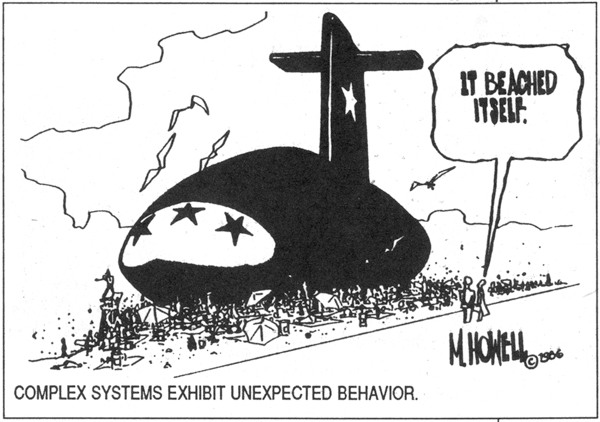
Originally published as Systemantics, the pun in the title carries the important message that systems have "antics" — they act up, misbehave, and have their own mind. The author is having fun with a serious subject, deciding rightly that a sense of humor and paradox are the only means to approach complexity. His insights come in the form of marvelously succinct rules of thumb, in the spirit of Murphy's Law and the Peter Principle. This book made me 1) not worry about understanding a colossal system — you can't, 2) realize I can change a system — by starting a new one, and 3) avoid starting new systems — they don't go away.
The lesson is that whatever complexity you are creating or have to work with — a website, a company, a robot, a tribe, a platform — is a system that will over time exhibit its own agenda. You need to understand the basic laws of systems, which this perennial book (now in its third edition) will cheerily instruct you.
-- KK
The Systems Bible
(3rd Edition of Systemantics)
2003, 316 pages
$7, Kindle
$18+ (used), paperbackAvailable from Amazon
Sample Excerpts:
*
*
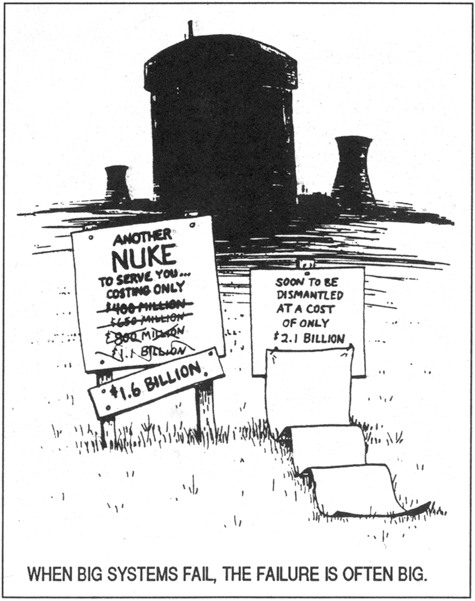
A complex system that works is invariably found to have evolved from a simple system that worked. The parallel proposition also appears to be true: A complex system designed from scratch never works and cannot be made to work. You have to start over, beginning with a working simple system.
*
We begin at the beginning, with the Fundamental Theorem: New systems mean new problems.
*
The system always kicks back — Systems get in the way — or, in slightly more elegant language: Systems tend to oppose their own proper functions.
*
Systems tend to malfunction conspicuously just after their greatest triumph. Toynbee explains this effect by pointing out the strong tendency to apply a previously successful strategy to the new challenge. The army is now fully prepared to fight the previous war



"Growing Cities" is a new documentary film about the rise of urban farming in the United States. When Dan Susman and Andrew Monbouquette, two young men from Omaha, Nebraska, become disillusioned with the lack of urban farming projects in their hometown, they strike out on a road trip. They are searching for people who grow their own food, who believe in the tremendous potential of urban farming, and who are changing their communities through growing food.
The filmmakers certainly find what they're looking for. It's not surprising that the West coast has many well-established urban farms. In San Francisco, municipal laws are lenient toward urban farmers, even inner-city livestock; and Seattle provides land to anyone willing to farm. Milwaukee, Chicago, and Detroit boast incredible operations that feed thousands, build community, and offer employment opportunities. New York City boasts impressive rooftop gardens; Boston continues to maintain an original, World War II-era Victory Garden; and farmers in Atlanta and New Orleans are working to make urban spaces green and productive, while training underprivileged youth.
Urban farming is beneficial for many reasons. It can offer much-needed nutritious food to urban dwellers. Many Americans nowadays live in what's called a "food desert," where local stores don't stock fresh produce regularly. In Detroit, for example, 550 000 residents (over half the city's population) don't have close, reliable access to vegetables and fruit.
Urban farming teaches Americans how to view vacant land in a new light. Wherever there's space, there's an opportunity to grow something. Even if you don't own the land, many landowners are happy to have someone actively improve and beautify their empty lot for free, while benefitting the community. As one Atlanta farmer explains:
"The hugest part of sustainability is having people understand the importance of caring for land, regardless of whether you think you own it or not."
Urban farming helps secure the national food supply. Americans have done it before, thanks to the tremendous growth of Victory Gardens during the two World Wars. Just a few years after being established, these homegrown gardens provided 40 percent of all produce consumed in the United States. There's no reason that can't happen again. Americans possess 35 million acres of lawns that could be productive.
What's needed is a cultural shift in the perception of agriculture. Farmers need to be raised up in our society, and regarded in a similar way to doctors and engineers. After all, farmers are the most important people in our lives because they are the ones who feed us. And people need to get their hands dirty, to learn about growing food in limited, compromised spaces. You'd be amazed at what's possible.
Growing Cities Trailer from Growing Cities Movie on Vimeo.
"Growing Cities" is definitely worth watching. It's inspiring, lighthearted, and educational, and has been very well received at film festivals. You can find a list of screenings here, or learn how to host your own. The film's website also has lots of helpful information for starting your own urban farming projects.

 Posts



From reader CB: Armstrong was wiser than many give him credit for. By protecting his mouth, he protected his career and enabled him to make statements in more lasting ways. An example of a promising career that was ruined by a slug to the mouth during a fist fight is that of trombonist Jimmy Knepper. You probably recall his recordings and performances with Charlie Mingus in the 1950s and early 1960s (some of his best - Tijuana Moods, Pithecanthropus Erectus, Mingus Ah Um come immediately to mind). His front teeth were broken or knocked out and he was unable to play thereafter.