Friday, November 13, 2009

In defense of losing

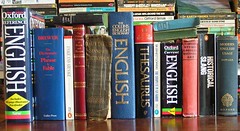
DictionariesRemember folks, these books are your friends. Computers are too stupid to warn you to distinguish between "loosing" instead of losing. Image by jovike via Flickr

Not as a practice, but as a unique word with its own spelling. There's hardly a day goes by that I don't see some formerly august publication or website unloose "loosing" where "losing" is the correct word. Today's example:
While boreal forests are under attack, the Greenland ice sheet is loosing mass at an accelerating rate. So reports a new study published in the journal Science. The mass loss is equally distributed between increased iceberg production, driven by acceleration of Greenland’s fast-flowing outlet glaciers, and increased meltwater production at the ice sheet surface. Recent warm summers further accelerated the mass loss to 273 Gt per year (1 Gt is the mass of 1 cubic kilometer of water), in the period 2006-2008, which represents 0.75 mm of global sea level rise per year. The Greenland ice sheet contains enough water to cause a global sea level rise of seven metres. Since 2000, the ice sheet has lost about 1500 Gt in total, representing on average a global sea level rise of about half a millimetre per year, or 5 mm since 2000.
Reblog this post [with Zemanta]

WORD: Our choice

American Physical SocietyImage via Wikipedia

Bob Park is a former president of the American Physical Society (APS), the professional organization for physicists.
WHAT’S NEW Robert L. Park Friday, 13 Nov 09 Washington, DC

1. CLIMATE CHANGE: APS TELLS DENIERS TO COOL OFF.
Two years ago the elected council of the American Physical Society adopted a strongly worded statement calling for reduction in the emission of greenhouse gases. The statement called the evidence for global warming "incontrovertible," which is about as far as you can go in that direction. There are, however, eminent physicists who do not agree. They petitioned the Council for a reconsideration of its statement. APS president Cherry Murray appointed an ad hoc committee, chaired by Dan Kleppner, to consider whether the statement needed to be revisited. The council overwhelmingly rejected a proposal to replace the statement with one favored by those who deny anthropogenic climate change, but the society's Panel On Public Affairs will review it for "possible
improvements."

2. EDITORIAL: WHAT HAS THE SPACE PROGRAM SHOWN US?
There is no place else to go. If global warming is real and we're the cause, we need to mend our ways. We are not going to clean up the Earth's atmosphere by burying carbon. There are just two things we can do: make fewer people, and use energy more efficiently. The first seems to be mostly a human rights problem; the second falls squarely on our shoulders, but it won't help if the fertility rate remains high. But what if carbon in the atmosphere is not a problem as the deniers insist? We ought to promote efficiency anyway, if only for the sake of future generations.
Reblog this post [with Zemanta]

SJ: Editors? We don' need no steenkin' editors

What is up with the Statesman-Journal? I wouldn't expect this from a high-school newspaper:
A Salem man accused of shooting a man and hiding the body was sentenced to life in prison in Marion County Circuit Court this morning. . . .
On Oct. 22, Garibay pleaded [sic] guilty to the charges, which also included a charge of possession of a firearm — and of a driving under the influence of intoxicants from a previous case.
So that's not a typo -- the writer knew the guy had already pled guilty, but then went ahead and used the term (accused) that makes it seem as if guilt was still a question. The real interesting question is how does something like this make it past an editor . . . or do they even use editors any more?

Thursday, November 12, 2009

I think, therefore I am. . . . Or at least I think I am . . .

On the so-called "Health Care" bill

Healthcare in America
Mary Vorachek, M.D., Salem, Oregon

Now that we have the worst healthcare bill that our representatives in government could contrive there is no place lower to go except the grave. Our government wants our money and the money of all our descendants for the enrichment of Wall Street, Detroit and the corporations; and our government wants the limbs and lives of your fathers, mothers, brothers, sisters and children so they can kill people in the Middle East, Africa, Colombia, Honduras, etc. (poor countries that are not respectful enough with people who are not quite white enough but with coveted resources that we wish to exploit because we think we can).

Our representatives in government give our taxpayer money to the corporations that then give some of it back to our representatives so they can continue giving more of our money to the corporations that impoverish America’s citizens. President Obama took money from millions of people who placed their hopes for a better America and a better world in a man who could talk a good talk but who has not delivered and seems reluctant to deliver anything substantial to the American people. A few crumbs may fall off the kakistocracy’s (rule by the most reprehensible elements of society) table, and we can scramble over our friends, neighbors and fellow citizens to lick crumbs off the floor but we will never have a seat at the table. Is it any wonder that Americans do not care about government? The government does not care about us, and the corporations that run the government do everything possible to disenfranchise voters.

The House of Reprehensibles has given us a bill that:

1) does not rein in insurance premiums,
2) has a public option with co-pays and deductibles that will continue to make insurance unaffordable and bankrupt its consumers,
3) ensures the pharmaceutical industry will never have to worry about losing patents on new drugs,
4) mandates the purchase of unaffordable insurance, and
5) will not cover comprehensive reproductive needs of women.

On the plus side, the Reprehensibles have given us an unaffordable bill that:
1) eliminates discrimination against people with pre-existing conditions.

The House bill enriches the private insurance and pharmaceutical companies and ensures the Reprehensibles of continued re-election coffers full to the brim. The insurance industry will get millions of new customers plus $500 billion for public option subsidies. And you will be charged with a federal crime if you do not qualify for the unaffordable public option but refuse to buy private insurance.

Tuesday, November 10, 2009

As Salem merrily plans a return to business as usual

The economic establishment accepts the world soon won't be able to meet energy demands, but wants to keep quiet about it

It is very hard for the average person in the street to come to a sensible conclusion on peak oil. It's a subject that prompts a passionate polarisation of views. The peak oilists sometimes sound like those extraordinary Christians with sandwich boards proclaiming that the end of the world is nigh. In contrast, the the international economic establishment – including the International Energy Agency (IEA) – has one very clear purpose in mind at all times: don't panic. Their mission seems to be focused on keeping jittery markets calm.

Faced with these options the majority of people shrug their shoulders in confusion and ignore the trickle of whistleblowers, industry insiders and careful analysts who have been warning of the imminent decline in oil for over a decade now.

Remember the Queen's question – that uncannily accurate and strikingly obvious question she put to economists at the London School of Economics a year ago after the financial crisis: did no one see it coming? Apply that question to peak oil and the answer is that many people did see it coming but they were marginalised, bullied into silence and the evidence was buried in the small print.

Take the 2008 edition of World Energy Outlook, the annual report on which the entire energy industry and governments depend. It included the table also published by the Guardian today, and the version I saw had shorter intervals on the horizontal axis. What it made blindingly clear was that peak oil was somewhere in 2008/9 and that production from currently producing fields was about to drop off a cliff. Fields yet to be developed and yet to be found enabled a plateau of production and it was only "non-conventional oil" which enabled a small rise. Think tar sands of Canada, think some of the most climate polluting oil extraction methods available. Think catastrophe.

What made this little graph so devastating was that it estimated energy resources by 2030 that were woefully inadequate for the energy-hungry economies of India and China. Business as usual in oil production threatens massive conflict over sharing it.

Now, this all seemed pretty gigantic news to me but guess where the World Energy Outlook chose to put this graph? Was it in the front, was it prominently discussed in the foreword? Did it cause headlines around the world. No, no, no. It was buried deep into the report and no reference was made to it in the press conference a year ago.

The fear is that panicky markets can cause enormous damage – panic-buying that prompts fights over resources, which in turn could lead to power cuts in some places and other such mayhem. But so far in facing this huge challenge, our political/economic system seems unable to cope with reality. We are forced to carry on living in an illusion that we have so much time to adapt to post-oil that we don't even need to be talking or thinking much about what a world without plentiful oil would look like. Reality has become too dangerous.

So in reply to the Queen's question of a few years hence, we did see it coming but we chose to ignore it.

The Most Awesome Book Review EVER

the pileThe raw material supply for the Freakonomics authors. Image by SerenityRose via Flickr

Elizabeth Kolbert on SuperFreakonomics in the New Yorker.Reblog this post [with Zemanta]

For Your Calendar

The Fellowship of Reconciliation presents

Claude AnShin Thomas -- Zen Buddhist Monk, Vietnam Veteran, and Award-Winning Author of "AT HELL'S GATE - A Soldier's Journey from War to Peace"

Public Talk on Sunday, November 22, 2009 at 7:30 p.m. entitled "Healing and Peace - The Hard Work of Transformation."

The talk will be given at First Congregational United Church of Christ, 700 Marion St NE, Salem, OR.

Claude AnShin Thomas traveled a remarkable journey from the devastating effects of experiencing childhood violence and combat to finding peace with his unpeacefulness. In order to find new possibilities to live, we need to learn about our conditioning to violence and how to embody peace.

Monday, November 9, 2009

A once-in-a-lifetime blog


Blog on a far-too-little discussed subject: planning for what happens when you cross that great divide over to the (real) far side. By the author of an excellent book, "Grave Matters."

What hath God rot?

Wrought iron on windowImage via Wikipedia

Best Craigslist spelling so far: "Rot iron pan/utensil hanger."
Reblog this post [with Zemanta]